Arranging the Silver Lining

Yesterday saw the premiere of a version of my arrangement of ‘Look for the Silver Lining’ at the Ladies Association of British Barbershop Singers’ annual Convention. It is a chart that comes with a story, not least of how it turns up in two versions simultaneously, and whilst LABBS members have heard some of that story at its premiere, others who might be interested in the song might not

Besides, in addition to all the background stuff about context and relationships, there’s the story of how the backstory shaped the chart itself.

The arrangement commission was funded by the Jen Mills Award, of whom the 2021 recipients were the quartet SoundHouse. The award commemorates Jen Mills, who was a source of great musical energy and insight in LABBS, as Music Judge, coach, and arranger until her untimely death in 2019, and it provides funding for a LABBS quartet each year to commission a new arrangement.

On the Value of Stating the Obvious

The musical directors of BABS had the opportunity on Saturday to hear a presentation from vocal health expert Julian Nicholl at our periodic MDs forum. Julian has that combination of specialist knowledge and kindness that gives you confidence the voices he cares for are in good hands; I particularly liked the way he recognised that while we all have the same basic vocal mechanism, everybody’s life circumstances - and thus needs - are individual.

At this point, I realised that my original title, ‘On stating the obvious’ sounded a bit dismissive towards Julian’s presentation, so I’ve gone back and tweaked it to better capture the reflections that followed.

One of his key points was that the things you need to do to nurture vocal health are exactly the same things you need to nurture any other aspect of health: get enough sleep, exercise and hydration; eat nourishing foods in adequate but not excessive quantities; engage in activities that promote positive emotional states and reduce stress, etc. And this is, in one sense, kind of obvious: a healthy lifestyle gives you the best chance in anything you do.

Zoning in on Experiential States

zones

It’s many years now since I first wrote about the different zones of experience, and I recently had cause to explore these ideas with The Telfordaires’ Music Team. We are preparing to welcome a group of relative novices to join us for a 6-week Learn to Sing in Harmony Course, and this model was a really useful way to frame the way we look after our visitors.

On Breath and Tempo

For the last year or so I have been attending tai chi classes in local parks. I tried it on a whim when I was looking for things to take me away from my screen, and have kept doing it both because it is enjoyable during the session and I always feel good afterwards. It’s good for a sense of balance, both physical and mental.

Recently our teacher, Perry, was making some interesting observations about breath and tempo in the context of the Form (the extended sequence of moves that always features in the last 15 minutes so of the class), and I found myself wanting to reflect on parallels with musicking. Breathing and tempo are, after all, pretty central to our craft too.

On the Whitewashing of Barbershop: A Case Study

Shine on meShine on me

This probably won’t be a long one as I’m not sure I have much more to say than, ‘Uh, look at this, the record needs correcting,’ but we’ll see how we go.

We all know by now that barbershop was originally an African American genre (though there was a considerable level of interchange between white and black traditions in its heyday as a commercial genre in the early years of the recording industry). We also know that when a revivalist movement in the 1930s led to the formation of the Organisation Formerly Known As the Society for the Preservation and Encouragement of Barbershop Quartet Singing in America (or TOFKASPEBSQSA as I like to think of it), the new institution not only excluded African Americans from its membership, but also systematically removed any mention of the genre’s black origins from its standard narratives.

It’s very easy to think that was all in the past and that now the historical record has been corrected we’re all done. Whereas in fact there are all kinds of ways in which we’re still living with the legacy of those decisions, usually without realising.

Explorations in Troubled Waters

Continuing with the theme of how returning to regular piano practice is having interesting cross-fertilisations with my vocal-harmony musical brain, today I’m going to share some discoveries made while working on Margaret Bonds’ piece ‘Troubled Water’.

The piece is based on the spiritual ‘Wade in the Water’ and was originally conceived as one of a suite, though it has developed an independent life having been published as a stand-alone piece in 1967. The suite was finally published in its entirety in 2020. I have linked to Samantha Ege's recording;'Troubled Waters' is the 3rd movement, starting at 6:58.

Coaching Conductorless Rubato

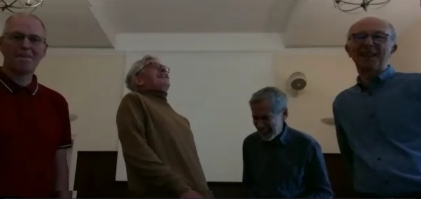
The main benefit of online coaching: good screenshots of people laughingThe main benefit of online coaching: good screenshots of people laughing

I spent a rewarding afternoon on Thursday with a quartet who had contacted me for advice about how to manage rubato in an ensemble without a conductor. They formed from within a choir they all sing in so are accustomed to using the visual signals from their musical director to coordinate them, and were finding the lack of this external guide one of the major challenges of singing in quartet, especially in music that isn’t strictly in rhythm.

We split the process into two distinct stages: how to rehearse, and how to perform. The former is where the group develops a shared understanding of musical shape and a shared awareness of each other in the ensemble. The latter needs a repertoire of interpersonal cues to transfer those understandings into the performance situation.

Miscellaneous Thoughts on Vocables

This post arises from a collection of random notes in my Thinking Book and conversations on social media, none of which were substantial enough to make a post of their own, but would if bundled together. So, a bit of a miscellany, but at least a themed one.

Vocables are the nonsense/neutral sysllables we use in a cappella to create accompanying textures. They are sometimes intended to evoke instrumental textures explicitly, but they’re often simply about creating a distinctive expressive profile for a song and providing expressive variety over the course of the musical narrative.

Change vocable when you change pattern

One of the things that takes up an awful lot of rehearsal time when working with human beings, especially human beings who work in idioms that involve memorising music, is handling the bits where a pattern changes. You set up a riff, and then some pesky musical detail like how the melody goes or a change in chord means you have to mess with it – in the process, messing with the singers’ heads just as they’d got settled into their stride.

...found this helpful?

I provide this content free of charge, because I like to be helpful. If you have found it useful, you may wish to make a donation to the causes I support to say thank you.


Archive by date

Syndicate content