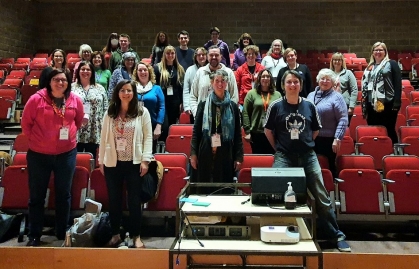
Overwhelmed to be Back at BABS Convention

Pic courtesy of BABS facebook feedPic courtesy of BABS facebook feedThis last weekend saw the first in-person barbershop Convention in the UK since before Covid. If the British Association of Barbershop Singers' Convention had fallen in its more usual spot in the calendar a month later, that honour would have fallen to Sweet Adelines Region 31, but that’s just how things worked out with public holidays this year.

Sing2022 was a smaller event than we have been used to in recent years. Both in terms of its duration – starting a bit later on the Friday, ending on the Sunday night rather than going into the Monday – and in terms of number of delegates. There were fewer competing choruses than usual, and many if not most of the choruses were visibly depleted in number since before the pandemic. This is a common experience amongst choirs across the country, not just barbershop, though people are starting to report a new uptick in interest as people feel more confident to go out do things again and are looking for new pastimes.

What is Vocal Freedom anyway?

VFPlogoHaving shared some of the background to The Vocal Freedom Project in a previous post, I thought it might be helpful to explore in a little more depth what I mean by the phrase ‘vocal freedom’ in this context. It is one of the ideas that is both multidimensional and holistic – you can think about it from a number of different angles, but in practice they all work together in a single, unified experience.

The Physical Dimension is the most obvious, in that it is the one we are most likely to directly perceive in ourselves and in others, both visually and aurally. We find physical freedom by shedding extraneous muscular tension – that is, muscular engagement that isn’t doing anything productive. Tongue, jaw, neck, shoulders, glutes are all areas we tense up when under stress then never quite loosen off again when the immediate stressor goes away. Our bodies get locked up, our breath becomes shallow, and we hear this in our voices as strain and loss of resonance. Vocal Freedom Project workshops start with the body as the dimension which is both most accessible and usually the most urgent to address.

On Creative Choices, Creative Intentions

Some of the voicings I have been puzzling overSome of the voicings I have been puzzling overOne of the orthodoxies of my musical upbringing and subsequent teaching life is that the performer should respect the composer’s intentions. In practical terms this entails, at the basic level, playing the music presented in the score accurately – i.e. all the pitches written, in the durational relationships represented by the notation.

This basic level is never really challenged, though it is inflected as you move educationally beyond a literalist approach to the score to understanding it as a document emerging from a historical and cultural context. ‘Style’ is the shorthand term used to embrace the range of types of information used as filters through which to interpret the written score: changing notational conventions, changes in the construction and thus sound of instruments, changing aesthetic ideals and their impact on tone production, articulation, timing, and embellishment.

Introducing the Vocal Freedom Project

VFPlogoToday tickets have gone on sale for the first of what will probably become a series of workshops called the Vocal Freedom Project. We’ve got quite detailed info about the VFP’s rationale and aims over on the project page, but I thought it might also be useful to give a little background into its genesis.

The project was born in a conversation back in early December with my friend Myra, who sang with me in Magenta for ten years. I can’t remember exactly how she phrased her expression of her need to sing, but she crystallized a lot of the observations I had been making over the months since live singing had restarted in the UK about what the lockdown experience had done to people’s voices.

Strictly/Frisson Double-Bill

Warm-up pic snapped at a particularly invigorating momentWarm-up pic snapped at a particularly invigorating moment

Last Thursday evening saw me coaching Strictly A Cappella, having spent the afternoon coaching Frisson quartet. Both ensembles are preparing for a concert coming up next week – and if you think the timing of the coaching is surprisingly close to the performance, you’d be right. Our plan had been to work together the week before, but Covid had other ideas.

Still, when you are working that close to a performance you get a very distinctive kind of energy and impetus to the experience. With both groups we romped through far more music than you would when digging deep at an earlier stage of preparation, with all attention focused on how to enhance the impact of music that is already essentially well under control.

Andy Allen on Chorus Processes

On Saturday, Andy Allen was invited to present at the quarterly Forum for MDs of choruses in the British Association of Barbershop Singers. For those who don’t know him, Andy is the brains behind the renaissance of Hallmark of Harmony, a once-great chorus that had by the mid-2000s fallen some way from its previous heights, while still being haunted by the memories of those past achievements. Andy led their transformation back to glory from around 2012, and they are the reigning British male chorus champions from 2019.

Now, Andy is a fine musician, but the thing I admire him for most is his skill and insight into building organisational structures and processes that bring out the best in the people around him. Indeed, one could hypothesise that one of the reasons he has such good people around him is his knack for figuring out how they can best make their contributions: there’s nothing like feeling useful to motivate people to stay involved.

LABBS Directors Day: Reflections on the Coaching Model

Rita Hulands has a genius for capturing pics of people immersed in what they're doingRita Hulands has a genius for capturing pics of people immersed in what they're doing

One of the features of last weekend’s Directors Day was hands-on practical work for all delegates. Faculty-led classes are a useful part of director training, but for skills-based learning you actually need to do the thing to get better at it. I had actually lined the model we used up to deliver in 2020, but we didn’t get to use it then. But it was ideal for our needs in 2022, as it all about connecting ear to gesture – that central driver of effective conducting that had been absent through the Zoom era.

The faculty met together the night before to do our own practical work. This doubles as both our opportunity to experience some input on our own directing before spending the main event helping everyone else, and the chance to work through the model so we’re all confident to deliver it to others.

LABBS Directors Day 2022

dirday2022

Almost two years to the day since the Ladies Association of British Barbershop Singers last held an in-person education event, we gathered in Coventry on Saturday for a day of director training. We had a curriculum built round various aspects of the recovery process all choruses are going through at the moment, underpinned by practical work for all delegates that focused on the relationship between listening and conductor gesture. This is the central element of the conductor’s craft, and precisely what had been ripped out of the process during the whole Zoom era.

A recurrent theme in this blog after these kinds of events is the sense of coming home with a full note-book. That cliché becomes meaningful again after such an education drought. For sure, there have been all kinds of online events to attend as either leader or delegate, and I learned things from both types of participation, but the richness and depth of learning you get with a room full of people is just in another league. I had conversations with a number of people about how we’d got to the point last year where we were just running on empty, and how nourishing it felt to finally spend time in person with other directors. The full pages of our notebooks reflect the refilling of our spirits.

...found this helpful?

I provide this content free of charge, because I like to be helpful. If you have found it useful, you may wish to make a donation to the causes I support to say thank you.


Archive by date

Syndicate content