On the Icicle 7th

Chinese 7thRecently Sofia Layarda started off an interesting conversation on Facebook about the chord that barbershoppers have traditionally called the ‘Chinese 7th’. For those not familiar with it, it’s a particular voicing of the dominant-type 7th, with the root and 7th close together at the top, with 3rd dangling a tritone below and the 5th a 6th below that.

It’s a dramatic sonority when sung well, though it takes a bit of nous to balance correctly. Arrangers use it as a kind of ‘statement chord’, placing it strategically to attract attention at moments of heightened expression in a song’s narrative.

Penny-Drop Moment

This is going to be a short one, but it deserves a post in its own right for the sense of revelation it afforded me when the idea plopped into my head.

One of the things I had been thinking about a good deal over the summer is keeping articulation small and precise, and in particular keeping the jaw at rest while singing. This is one of the things that Sean Bui worked on with the Telfordaires in June when he came to us for a coaching session, and it has proved both transformative and challenging. Until we started applying this as a means to reduce tension and improve resonance, we hadn’t realised how much the chorus had been accustomed to experiencing muscular engagement as part of emotional intensity.

David Wright’s List of Key Changes

One of the subjects that came up at the arrangers’ day with David Wright back in August, unsurprisingly, was key changes. In fact, it came up each time we studied a chart that included one, and so David periodically gathered together the threads to give us an overview of the range of possibilities we had explored so far. And once I had likewise gathered them together in my notes, it looked like the kind of list to share.

So, here are four ways that came up that day to get into a new key:

Workshopping with Just Voices

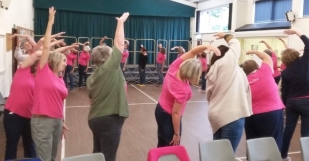
Warm-up action shot!Warm-up action shot!

I spent the weekend down in the second most eastward point of the UK, where Just Voices had convened to hold a weekend’s retreat in Broadstairs. We structured it as two one-day workshops on contrasting themes, but addressing a common core of pieces from their repertoire.

Saturday saw us focusing on the singers as musicians, with a bespoke workshop on Aural Skills for Choral Groups, while Sunday took our attention back out onto the audience with the theme Perform with Panache. We had slightly less time at our disposal on Sunday, though, so we compensated for that by taking the opportunity of the Saturday evening together to prime some ideas to be working on overnight.

Reflections on Coaching: Transformative or Flashy…?

My friend Stefanie Schmidt once made the comment that the kind of coaching sessions she finds most valuable are the ones that give her a concept or a technique she can go away and work on. These may not on the face of it look like the most impactful sessions, as the results aren’t immediately audible, but rather emerge later, and over time. But they make the greatest difference in the longer term.

She contrasted these experiences with those she termed ‘flashy’ coaching. The latter make major changes to the group’s performance, generating great enthusiasm and emotional energy, but not necessarily leaving the group with the wherewithal to recreate the same effect when the coach has gone home and left them to it. Flashy coaching’s legacy can actually to be to undermine the self-belief of people who have been given a glimpse of greatness but find themselves unable reach it again by themselves.

Am I Arranging in Time?

question markOne of the early topics I dealt with in this blog is to consider what arrangers can do to help people sing their music in tune. My listening experiences in recent years have had me thinking about the ways arrangers help or hinder singers in singing well in rhythm.

This is a particular issue for barbershop arrangers, who are working in a genre that on the one hand is quite self-aware about having a rather shaky relationship with rhythm and on the other has taken to syncopation and other forms of rhythmic complexity as an index of coolness. Arrangers pile push-beats on triplets to make the music wiggle its hips and thereby prove that they are sexy and clever rather than simply nerds (music theory geeks) amongst nerds (barbershoppers in general).

Some Ideas to Sleep On…

walkercoverOn my way out to Nashville for Harmony University, I picked up Matthew Walker’s book Why We Sleep at Manchester Piccadilly station, as a likely-looking good read for the journey. Not only was I right about that, but the things I learned from it interacted in interesting ways with the material I was teaching all week.

The headline take-away from the book is this: please make sure you give yourself enough opportunity to sleep properly, for the sake of both your health and your effectiveness in everything you do. There’s nothing like detailed empirical substantiation of what you knew to be common sense to motivate you to be more sensible.

But onto more specific, indeed, niche take-aways…

Motivating the Moves with the Chordettes

chordettessep18Sunday took me down to Devon to revisit the Chordettes in the run up to their contest performance at the Ladies Association of British Barbershop Singers Convention next month. In the three months since I last saw them they have embedded many of the things we worked on back in June, especially their bubbling embouchure and bucket-cup-teaspoon breathing, and were ready to move onto coaching more focused on the audience experience in anticipation of bringing their songs to the stage.

...found this helpful?

I provide this content free of charge, because I like to be helpful. If you have found it useful, you may wish to make a donation to the causes I support to say thank you.


Archive by date

Syndicate content