Arranging

Arranging from someone else’s arrangement

‘The Things We Do for Love’, due to enter my catalogue next week, is the first of a smattering of arrangements I’ve been asked to do where the people who commissioned it were inspired by another a cappella group’s rendition of the song. In this case, it was the Vocal Six’s arrangement. Another example due to become available in the coming months is Sense of Sound’s performance of Justin Timberlake’s ‘Cry Me a River’ on the TV series Last Choir Standing.

On first sight, I found this a slightly intimidating task. When you’re transforming a well-known original to an a cappella ensemble, there are all sorts of ways you can worry about not living up to the original, but you know that at the heart of the game is the dual sense of recognisability and distance. The pleasures derive from both connecting with the original version and hearing it in a new guise.

But when someone has already leapt across that gap, what is the second arranger to do?

Obsessiveness, Reluctance and Excellence

When I was organising the mutual mentoring scheme for arrangers, I had several conversations in which people said words to the effect of, ‘Oh, I must get round to doing some arranging’. I found this an interesting response because it is so different from my own relationship with arranging – which is probably best described as compulsive.

My first reaction was more judgemental than I like to admit: that the response was tantamount to an admission of mediocrity. If an activity is something you feel you should get round to, you’re just not doing it enough to be any good at it. You just wouldn’t say that if the activity was a regular part of your life’s activity.

Then I noticed I was being uncharitable, so tried to think a bit more openly about it.

How much do we know what we’re doing?

John Mayer: music as intellectJohn Mayer: music as intellectAndrew Downes: music as feelingAndrew Downes: music as feeling

At one point we had a pair of composition teachers at Birmingham Conservatoire who seemed to get on very well, but nonetheless had diametrically opposed views about how we should approach music. John Mayer used to harangue me over the photocopier about how music was nothing to do with the heart, but was an intellectual pursuit, while the then Head of Composition and Creative Studies, Andrew Downes used to say that you should never analyse anything, it should all come from the heart.

No Room at the Inn…

As you’ll see from the notice on the front page, I am not taking any new orders for bespoke arrangements for the time being. It’s not that I’ll be slowing down in my arranging activity – it’s just that I’m booked up now until September, and that’s enough for the time being.

It was towards the end of last summer that I decided to regulate the flow of arrangement commissions by scheduling two per month. I had been hammering hard at it for some months already, and the requests started to come in faster than I could cope with them. It wasn’t just that I wanted to do other things with my every waking minute (I rather like going out and working with real live singers as well, for example), it was that I was starting to feel almost bloated with the amount of music I was absorbing in the process.

So, having booked up the two slots per month this far ahead, I have decided to stop accepting commissions until nearer the time I will be able to fulfil them. This is for both pragmatic and artistic reasons.

Key Choice

How to pick the correct key for an arrangement is a core part of our basic craft as arrangers, and there are standard ways of going about it. To begin with, there are the ‘typical’ ranges for each part, and you’d start off by seeing which key would leave the melody lying in the classic range for a lead.

There isn’t always a single obvious answer from this initial process, though. Very rarely, a tune sits well within the standard range, giving room to move it up or down; more often it is going to spill over at either top or bottom. The decision at this point is inflected by multiple considerations that may not all point to the same answer. Clearly there’s the question of who is going to sing it: preferred voice range is something I’ll always ask for a commission, and I prefer it if I know the sounds of the actual voices too. It’s always good to keep your lead happy, after all.

On Range and Tessitura

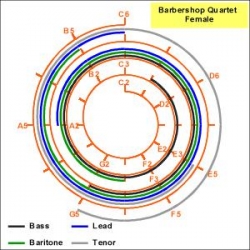
A rather nice way of showing vocal ranges visually, from PhonatureA rather nice way of showing vocal ranges visually, from PhonatureThis week saw the addition to my arrangements catalogue of information about the ranges for each part. It took quite a long time to work through all parts of every arrangement, but I’m hoping it will save you time in emailing me to ask, and me time in answering. And the process gave me lots of opportunity to reflect on the meaning and usefulness of this information.

At the most basic level, range is the primary criterion for deciding on an arrangement’s suitability for a particular ensemble. If the person singing that part doesn’t have notes used at either top or bottom, there’s no point attempting the song, as it will always over-stretch the group – and at key musical points, too. (Extremes of high and low notes never appear casually or en passant.)

But range doesn’t tell you everything you need to know about how a song lies on the voices.

Unity and Variety

The balance between unity and variety in music is a technical/artistic challenge that composers have been grappling with for probably as long as they have been writing music. It seems to become a more urgent issue, however, when you head into the nineteenth century with the development of the idea that works should be individual – that they should have recognisable identities that distinguish them from all other works. There are all sorts of reasons for this aesthetic shift, but changes in listening habits are indicative. When the orchestra is the background music for a duchess’s card game, symphonies can be more generic, but when the lights are lowered to put everyone’s attention on the orchestra, the music needs to do more to distinguish itself.

Those of us writing a cappella arrangements of popular songs from the last century might be working on a more modest scale than the nineteenth-century symphonists, but we face similar artistic and technical challenges. Specifically, there is the question about how much to repeat stuff. It’s a simple question, but the answer is always interestingly non-obvious, because of the effect that repetition has on a piece’s sense of identity.

Exam Results

Noteorious at their Maida Vale recording sessionNoteorious at their Maida Vale recording sessionWell, Noteorious have enjoyed a good bit of airplay this week on Radio 1 – appearing not only at ungodly o’clock on Dev’s show, but popping up elsewhere through the days to promote the Masterpiece shows each evening. So, I think that means I passed the arranging test. And for those who have been sensibly asleep first thing in the morning, there are now some nice videos of them singing the arrangements on Dev’s website:


Daft Punk
The Clash
The Streets
Metallica
And an interview with clips of all four

...found this helpful?

I provide this content free of charge, because I like to be helpful. If you have found it useful, you may wish to make a donation to the causes I support to say thank you.


Archive by date

Syndicate content Syndicate content