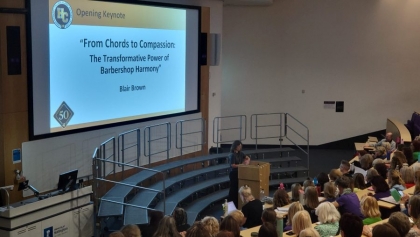
It’s a good long while since I’ve written about musical charisma, which was one of my regular topics of interest in the early years of this blog. If I’d stayed in academia, that would have been the area for my next scholarly monograph, emerging out of ideas I had to leave to one side as I wrote my book on choral conducting. But Blair Brown’s keynote speech at LABBS Harmony College got me thinking about it again.
In general culture, we tend to regard charisma as something that inheres to the individual, as a special or magical quality. However, the sociology of charisma suggests that it is something that is experienced in particular circumstances, arising from the relationships between members of a group as well as with its leader. Certainly some people are more adept at galvanising charismatic experiences within these circumstances, and indeed at facilitating their set-up, but they do it using somewhat standardised – and thus analysable – techniques rather than by any inherent magic. (Though as we shall see later, the belief in this magic is implicated in making a group susceptible to charismatic encounters.)

