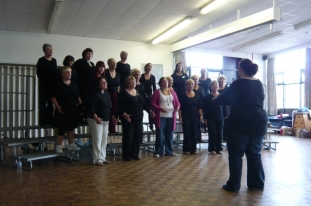
Cleeve Harmony and the Nature of Performance Traditions

cleeveI had a rich and fascinating evening working with Cleeve Harmony near Cheltenham on Tuesday. This is a new barbershop chorus, only 10 months old, and while its membership profile is very typical in its mix of people with previous experience and people new to singing, it is striking for having only one member - its founder-director, Donna Whitehouse - with any previous barbershop experience.

My remit for the evening was primarily to help them with director-chorus communication - working with Donna on aspects of her technique, and working with the chorus on making sense of what she's doing. One of the rewarding things about such an agenda is the sense that whichever end of the equation you address, you also help the other.

New Music and Performing Confidence with Vivat!

Vivat! demonstrating the technique of standing on one leg to engage the coreVivat! demonstrating the technique of standing on one leg to engage the core

Almost exactly a year since I last worked with the West Midlands Police Choir, I was back for another workshop with them on Saturday. They have rebranded as Vivat! and have the air of a much more established choir since I last saw them. This shows not just in seeing more people at the workshop, but seeing them build the infrastructure of longer-term projects and more ambitious, such as fund-raising for a trip to France next year, amongst their more immediate rehearsal and performance goals.

The workshop had two main areas of focus.

With a Lighter Heart(beat)

heartbeatThursday took me up to Marple to work with my friends in Heartbeat Chorus. It's a couple of years since I've visited, and they have attracted lots of new members in the meantime - a sure sign that something has been going well there.

So the lightness in the title was nothing to do with numbers - quite the opposite! In fact, part of our challenge for the evening was taking a body of sound that big and getting the nimbleness and flexibility that their repertoire was asking for. I don't know why larger bodies of people should, en masse, feel like they need to move more deliberately - probably something to do with the attention required to coordinate with greater numbers. But I guess it is why it is commensurately more exciting when you achieve dexterity with a big group.

So we experienced lightness in several dimensions.

Raising the Stakes in Rehearsal

Back when I was taking lessons in Alexander Technique, my teacher introduced me to bit of psychological re-framing that I found rather striking. It was to do with habit and habit-change (of course - that is central to what AT is about), and how you manage at that point when you do something when you remember to, but often forget and let habit take over. 'If I gave you £200 every time you did this, would you do it more often?' he asked. 'Well, I can't afford to do that, but if you are able do it for £200, you are able to do it for nothing.'

What he did here was to raise the stakes. He changed forgetting to do something from a matter of little concern to one of significant lost gain. Never mind that it was purely hypothetical, he had me more emotionally and attentionally invested in the exercise.

How Much are you Hearing?

We all know that listening is central to ensemble music - the participants listening to each other, and in bigger ensembles, the director listening to the whole. And if you asked any member of an ensemble if they were listening, they would reply that of course they were. But equally there may be all sorts of stuff that's going on that they're not hearing. Why is this?

  • They may be focusing so carefully on their own part that everything else is shunted to the very edge of their attention. Another, involuntary, version of this is when a dose of adrenaline induces tunnel hearing
  • They may have got so used to how the ensemble sounds that they have ceased to notice things that could be improved. Persistent tuning or synchronisation errors are often in this category. Combine these first two experiences, and you start to grow some flaming pink hippos
  • They may not have the perceptual categories to identify an issue, or their scale of perception is not sufficiently fine-grained to make the distinction.

Am I Musical?

question markThe term 'musical' is one that puzzles me greatly. You might think that someone in my line of work would know what it means, but in fact I see it being used in multiple different ways. Some of these I find at least moderately problematic, especially when they get muddled up with other uses.

(Indeed, when I was involved in writing course documentation for degrees in performance and composition, we avoided the word 'musicality' in favour of 'musicianship' for precisely this reason. There's enough anxiety around assessment criteria without loading the terms.)

The term gets used in (at least) three different ways.

Emergency Moments: Care of the Voice

I had a question by email the other day that my correspondent thought 'might make an (urgent) blog post' - as she recognised it is unlikely just to be her and her friends dealing with it.

Competition in 10 days time...problem with voices - people have sore throats from the changing weather, people have tired voices...even breathing was a problem.

How do we get around it?

I suspect that we should have put things in place months ago to avoid this 'stamina' issue, but it is very common.

Should we rest our voices? Can we do effective practice without singing?!

So I think she might be right there. This sounds a very normal problem to be facing.

Digging Deeper with the Red Rosettes

Red Rosettes Sept 2013Sunday saw my final, and longest, visit to the Red Rosettes before they fly off to Ireland to participate in this year’s IABS Convention. Having seen them in May, and then a month ago, it was cheering to be able to tell them that I could hear their progress from each visit to the next. This is what you’d hope would happen, of course, but it’s not always perceptible to the people plugging away week in week out.

At this stage of proceedings, it is of course far too late to mess with the general game plan. Whilst I usually describe my role as to go around messing with people’s heads, it’s also one of my life’s goals to increase people’s confidence, and making late changes to performances is a good way to have the opposite effect. So, apart from focusing in on a few isolated technical details that would benefit from specific attention, the day’s activities focused on taking a well-shaped and well-prepared performance, and making it more vivid.

...found this helpful?

I provide this content free of charge, because I like to be helpful. If you have found it useful, you may wish to make a donation to the causes I support to say thank you.


Archive by date

Syndicate content