Discoveries with Silver Lining

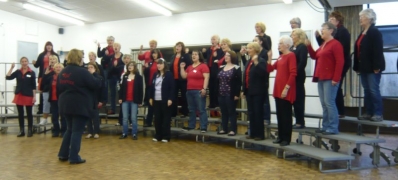
SLjun13Saturday took me over to Coventry to work with Silver Lining chorus. I have visited them a number of times over the years, though not for a while, and they have developed considerably since my last visit - both in size and assurance. Their director, Sara Jackson, had sent me a to-do list of things it might be useful to work on, with the proviso that if I identified something I felt was more important or urgent, that could queue-jump.

The way this played out in practice was that I went in with some specific plans for coaching tactics right from the get-go, and was then able to diagnose and start to address other coaching needs from within those activities. It felt like an efficient way of working.

The Toggle Principle

I have mentioned the rehearsal tactic of using a 'toggle switch' in various posts on coaching visits and rehearsals, but it occurs to me that it deserves a post of its own. Not least so that I can link back to it when I mention it in future without having to explain it again every time!

The way it works is that you designate an object or spot in front of the ensemble as a switch, which toggles the group between two different states every time it is operated. In theory it can be operated by anyone in the ensemble, though with bigger groups sometimes you need to limit access to those towards the front who can get to it easily.

Examples of states I have used this to toggle between include:

LABBS Directors Day

The delegates in songThe delegates in songSunday saw 95 chorus directors, assistant directors and directors-in-waiting from the Ladies Association of Barbershop Singers convene in Birmingham for the day. That is a lot of people, I should add. We had run a consultation exercise last autumn which not only fed much of the content of the day, but had led us to project an expected attendance of about 70 delegates, and even a month ago that still looked about right.

Don't get me wrong - I was delighted with the huge response to the day. But the last flourish of registrations before the deadline had me worrying over the published programme and whether we had left enough time for the breaks, and how the noise levels were going to be in discussion sessions. One of the great things about working with directors, though, is that they understand such dilemmas and readily cooperate to make the logistics work. We also had the splendid 'sheep dog' skills of Anne Potter, who rounded everyone up regularly to keep us running to time.

The Benefits of Fresh Blood

When I was at Preston last week, one of the Red Rosettes remarked to me how seeing the way their new members were so excited about what they were doing had made her feel excited again too. It got me thinking about what bringing new members is does for a choir. We usually think about this in terms of numbers and choir survival - if we don't replace those that leave (which is inevitable for reasons of health, work and family, however healthy the choir is in spirit), you eventually run out of singers.

But this conversation got me thinking about the more intangible benefits a choir gets from new members. On the face of it, inducting new people carries something of an overhead. However experienced the new recruit may be, they still need to learn this choir's particular habits, routines and - in the case of repertoire groups - music. But I tend to think not merely that this overhead is worth it for the gain of new members, but that going through this process periodically itself benefits the group.

Cheshire Chord Coaching

CCCThursday took me up the M6 to Warrington for my second trip north-west in two days, this time to work with current LABBS chorus champions, Cheshire Chord Company. We were working on two songs at different stages of development - the first only recently off the page and thus still at a stage where it could be pulled around and played with considerably, the second a show-piece already in the performing repertoire where the task was to refine the execution of the vision.

The Red Rosettes, Exploring the Song

redrosettes1

Last night was the first of two consecutive trips north-west, this one to coach the Red Rosettes in Preston. Much of the evening was dedicated to bringing out the expressive shape of a show-piece they are currently learning. But we also spent some time on the song they had used for a recent Learn to Sing course in order that their new recruits could have their first experience of being coached.

Chatting to a couple of these singers afterwards gave an interesting insight into what this experience was like for them. One spoke of the way she found it initially very challenging as it was asking her to let go of the way she had learned to do things. I thought this was a beautifully simple and to-the-point way of articulating that process of moving up from the basic operations of a new skill. Fortunately she seemed ready to take on the challenge and looked all lit up with that glow you get from achieving something new.

Pick 'N' Mix Rehearsing

Sometimes you find yourself running a rehearsal in a completely new format and it works.

I recently found myself needing to plan a Magenta rehearsal in which the primary need to be met was the capacity to maintain a breadth of repertoire in our heads. Our newest material had been absorbed and had its first performance, and we'd given recent and detailed TLC to those parts of established repertoire that had needed it. So in the week before we started our next new material, our biggest challenge was in making sure the fruits of this work were accessible at will.

Now, we could have spent the evening simply singing through our entire repertoire. That would have been boring and tiring and would have given use the opportunity to practice in mistakes. So, maybe not.

'Other People's Music': On the Copycat Performance

There is an approach to developing a performance that substantially borrows the gestures, pacing, emotional shape and styling of another musician's performance of the same piece. This approach is often referred to dismissively as 'copycat' performances, or 'other people's music'. The critics' view is that people should develop their own interpretations, make the music their own, and that copycat performances are derivative and thus artistically empty.

Now, I am not going to argue against these critics. I have also been brought up in artistic traditions that value an individual's own take on a piece, that regards the point of performance as to give a view of some music that nobody else could give. But still, the people doing this aren't going out of their way to generate empty, clichéd performances. They experience them as real, as heartfelt. So I thought it worth stopping to investigate in a bit more depth what's going on here.

...found this helpful?

I provide this content free of charge, because I like to be helpful. If you have found it useful, you may wish to make a donation to the causes I support to say thank you.


Archive by date

Syndicate content