Close-Harmony Singing Intensive

mozfest2012

It is absurd to expect a group of amateur singers, two-thirds of whom have never sung together before (and some of whom have not sung since they left school), to learn a four-part close-harmony arrangement from scratch in less than three hours, isn't it? And you wouldn't necessarily expect them to keep the tonal centre rock steady throughout, would you? And it would certainly be too much to expect them to perform it from memory at the end of the afternoon, yes?

There is often a moment in the days before one of the workshops that Magenta periodically offers for our local Moseley Festival, that I too think this is impossible.

The Belles of Three Spires

Digging into the musical detail...Digging into the musical detail...

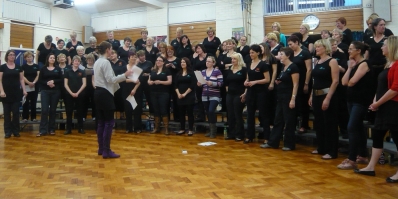
Wednesday took me off to Coventry to work with the Belles of Three Spires under their new director, Lucy Edmonds. New, perhaps, but clearly organised – Lucy had booked the coaching session several weeks before she was even due to take up the post.

I have reflected before on how you get different benefits from seeking coaching input at different phases in the learning of a piece: at the earlier stages more of the singers’ brains need to be tied up with remembering what they’re doing, which can be an obstacle, whilst at the later stage you are contending with more deeply ingrained habits, which is a different kind of obstacle.

We spent a fair chunk of the evening on a very new song.

Coaching with Phoenix

Phoenixjul2012Tuesday evening saw me back with Phoenix chorus for an evening's coaching - nice not to leave it for six years before a re-match this time! My primary remit was to work with them on an arrangement they had commissioned from me last year, and which they have scheduled to perform in a couple of shows this September, though we also looked at a couple of other pieces to refresh our musical palate.

Most of our work was in the realms of musical characterisation, bringing out texture and colour implicit in the musical shapes. I always tend to think of this process as one of sculpting: developing the flat canvas of beautiful vocal tone into a more three-dimensional musical shape.

Singing and Dancing in the Rain

The main stage and its superabundance of flowersThe main stage and its superabundance of flowers

Actually, there were some patches of glorious sunshine during last week's Llangollen International Musical Eisteddfod, but these were sandwiched in between days of persistent rain, punctuated by some impressive thunderstorms. The River Dee was transformed from its usual summer guise of sparkling backdrop for photo-calls into a raging torrent, and the guys selling wellies and brollies up on the Eisteddfod Field were doing very good business indeed.

But the people who had travelled from around the world continued undaunted.

The Effects of Missing the Warm-Up

Choir directors sometimes find it a bit of an uphill battle to persuade all their singers that they really need to be there for the warm-up. This is a subject I’ve talked about before, but a recent experience shed a particularly vivid light on it. If one person comes late for the warm-up, the difference it makes is perceptible, but the warm-up is still effective. If nobody is there for a warm-up, everyone suddenly realises what it is they have missed.

The occasion was a concert Magenta had been asked to perform in, at which there would be no facilities to warm up. The organisers apologised, but explained, not unreasonably, that their budget didn’t run to hiring extra rooms. Nonetheless, it was a gig we wanted to do for all kinds of reasons to do with relationship-building and good karma.

Scoring Artistic Quality: the Meaning of Numbers

I recently received an email asking if I might like to write about the experience of being an adjudicator - which of itself is quite a broad topic, and one on which I have wandered across occasionally in previous posts. The email then homed in on a much more specific kind of question, as follows:

What I'm particularly interested in is the fact that in my experiences, it seems to be really difficult for a chorus at music festivals get less than 75%, no matter how bad they are, and the difference between results for barbershop choruses in a festival may be just 5%, but when that is transferred to a barbershop competition, the spread is 30% +, which means that you then have to try to explain to the chorus why they can do so well in a general festival compared to a barbershop comp.

Now, this is one of those questions that has what at first looks like a simple answer, but when you live with it for a while, you see that the simple answer contains within it a rather more interesting point.

The Stimulating Rehearsal

A friend of mine was telling me recently how she and her co-director had re-stacked their chorus using a method of assessing each singer’s voice for its type of resonance, and using that to determine placement. She remarked how quite a few of the singers were really quite agitated about the part in the process where they had to sing alone to be assessed – even though it was only ‘happy birthday’, and done in private, not in front of everyone else. Still, they felt the process was worth it when the restacked chorus sounded significantly better than before.

Now, the thing about this kind of story is that it’s supposed to be about the value of the stacking method, but you can’t help wondering how much of the improved sound is actually a result of the process. That little dose of adrenaline the singers got from their fear of singing alone will have shunted them up the Yerkes-Dodson curve to a state of enhanced performance, whilst the steps taken to keep the process not too scary will have prevented them over-shooting into counter-productive anxiety.

LABBS Quartet Prelims

And at the end of the day, the draw for ConventionAnd at the end of the day, the draw for ConventionOn Saturday, the Ladies Association of British Barbershop Singers came to the Streetly Academy in north Birmingham to hold their preliminary contest round for quartets wishing to compete at the annual convention in the autumn. The really useful dimension of this event is not so much the competitive element (LABBS has not historically had so many quartets that we always need an elimination round for scheduling/logistical purposes), but its educational dimension.

...found this helpful?

I provide this content free of charge, because I like to be helpful. If you have found it useful, you may wish to make a donation to the causes I support to say thank you.


Archive by date

Syndicate content