Interruption of service...

Quick apology to regular blog readers for the absence of yesterday's post. I am just recovering from a 48-hour loss of internet connection. All is fixed now, but I'm all booked up over the weekend so will not be posting again until Monday.

Thanks for your patience, and have a nice weekend!

The 5-30 Practice Programme: Time to Report

Quick reminder to those who have been participating in June’s singing practice experiment: please let me have your feedback on how it has gone for you.

What you need to send in are three things:

  1. A list of days you did/did not actually do the practice routine
  2. Your notes from the end of each week on how you found it as you went through
  3. Your final notes on the overall experience

Having said that, if you don’t have all of those, just send in what you do have.

Welwyn Well in Harmony

Welwyn
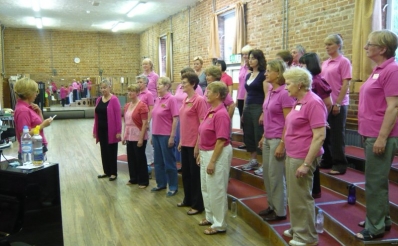
I had a fun evening on Tuesday coaching Welwyn Harmony. Earlier in the year they had commissioned an arrangement from me of ‘When I Fall in Love’, and part of our agenda on Tuesday was to work on this. I never lose the thrill of the first time I hear an arrangement sung – it’s like being in two places at once to hear something that used to just exist inside my head becoming physically audible!

And of course the possibility that I might be asked to coach a group I’ve arranged for is an important force to keep me honest as an arranger. It’s so easy, when you’re sitting at home by yourself to think, ‘Well it’s a bit awkward, but I’m sure the baritones will manage it.’ But if you know you’re going to have to face them, and indeed help them round the obstacle course you’ve constructed for them, it’s a great motivation to make the effort to make the lines singable.

Bristol Fashion Takin’ it Slow

BFjun11

On Sunday I was back with my friends in Bristol Fashion, for my fourth coaching visit since May 2009. And what a difference they have made in two years! The clarity, resonance and confidence in their singing has really improved, and each time there are more singers on the risers – it is a sure sign that things are going well when you have more people wanting to join than are leaving.

One of the encouraging aspects of coaching this chorus is that each time I go, I find the things we were working on last time well embedded and secure, allowing us to move onto new challenges. The chorus uses the technique of bubbling for continuity of breath and enhanced resonance with so much more ease and security than this time last year, and the issues over synchronisation we focused on last August are likewise much improved.

On Intrinsic and Extrinsic Rewards

caseforhandsI’ve recently been reading Matthew Crawford’s book The Case For Working With Your Hands, which is an extended critique of modern education and workplace practices. It’s one of those books where the over-riding impression is, ‘a bit ranty, but he’s a got a point’. Specifically, actually, the framing chapters are where it’s most ranty, and the middle is where he develops his more positive and compelling case about the relationship between intellect and ethics manifest in practical tasks. So if you can get past the opening, it’s worth it.

Carfield Community Charisma

carfieldjun11I spent Monday evening in Sheffield working with Carfield Community Choir on their performance skills. Last time I saw them we were working on ways to develop a sense of ensemble, and they have definitely developed a much greater sense of cohesiveness since then. They are now at the stage where they are ready to move on from a definition of success that is about not making mistakes to one that is more artistically ambitious, and it was a great pleasure to help them explore this new and exciting territory.

On Musical Fluency

When you listen to a lot of live performances, you start to observe patterns of behaviour that you wouldn’t notice watching only a couple of times. So the recent rash of barbershop quartet contests I’ve had the opportunity to watch, whether as judge or audience member, have given me new insights into how adult amateur musicians operate.

What I have learned is that there is a consistent correlation between how a quartet sings a tune-up chord and how they deliver the song that follows, both vocally and gesturally. There are three possibilities:

Metaphors, Emotions and Confidence

My friend Sarra recently sent me a link that included chapter from Anthony Pay’s book-in-progress on the use of metaphors in clarinet teaching. At least I think it’s still in progress – the text was from some time ago but I can’t find any evidence yet of its publication. Anyway, when it does come out, I’ll be happy to recommend it on the basis of this extract. He is clearly an experienced and thoughtful teacher – thoughtful both about the processes of playing his instrument, and about how people learn.

The overall thrust of his argument is that metaphors are useful aids to the learning process, and that different metaphors give access to different aspects of the task you are trying to learn. This is a subject on which I have been known reflect, too, of course.

One of the examples he gave was of the metaphors we use to describe emotional states:

...found this helpful?

I provide this content free of charge, because I like to be helpful. If you have found it useful, you may wish to make a donation to the causes I support to say thank you.


Archive by date

Syndicate content