How Did That Go?

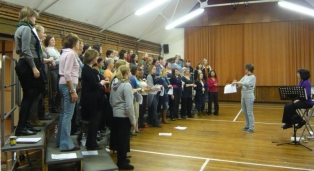
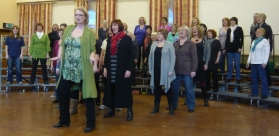
question markI’ve had several conversations with choir directors over the years about the experience of coming off stage from a performance and having your singers ask you how the performance went. Apparently I’m not alone in finding this a slightly baffling question.

The immediate response is, ‘Well you were there too – what do you think?’ It feels odd to be asked to pass judgement on an experience that the questioner was also participating in. But from the singer’s perspective, of course, it makes perfect sense to ask, since their routine experience in rehearsal is to look to their director for feedback on how they’re doing.

So there’s an interesting difference here between the director’s state of mind in rehearsal and in performance. In rehearsal, you’re using your analytical, or diagnostic ears. The task is not just to perceive what’s going on within the ensemble, but also to articulate it.

In performance, though, this feedback function transmutes into a role that’s much more about regulating than reflecting.

Unsynchronised Singing

One of the perennial challenges of singing in small ensembles is simply singing together. It’s one of the primary marks of competence, second only probably to tuning. And, like tuning, underneath the basic observation that it is or isn’t working are a whole host of different types musical problems. I have become increasingly interested recently in listening for the details of poor coordination in an ensemble as a means to diagnose how to help them cure it.

I’m thinking here specifically of ensembles that sing without a director, I should add. In theory, having all singers coordinate with the gestures of a single individual out front should solve this problem. In practice, of course, synchronisation is an issue for choral groups, too. Sometimes this arises from the types of problem listed here, but sometimes it arises from things the director is doing, so it’s something of a separate question.

So far, I have identified the following ways of not singing together:

A Champion Evening

coachingamershamOn Tuesday I had my first coaching session with Amersham A Cappella since they won both the Good Housekeeping Choir of the Year competition and the LABBS chorus championship within two weeks of each other last October. They are still wearing the extraordinarily broad smiles they acquired then, and are pushing forward to build on the performance gains they made during the previous year.

Both of the arrangements we worked on on Tuesday were show pieces that use a lot of the techniques of contemporary a cappella instead of (and/or in addition to) the techniques of core barbershop. So, homophonic close-harmony textures appeared somewhat sparingly, to be replaced by more layered textures, largely driven by nonsense word-sounds (‘vocables’) used for their evocation of instrumental timbres. Hence, much of our work revolved around teasing out the details of these different textures, and balancing out the layers.

Love & Rhythm

heartbeat1The New Year’s coaching season launched off at the weekend with a visit to Heartbeat chorus in Cheshire, under their new director Nancy Kelsall. The goal was to kick off their preparation for the Sweet Adelines Region 31 convention in May after all the distractions of seasonal performances before Christmas. As current bronze medallists, they are approaching this with a distinct sense of purpose.

Over dinner on Saturday night, Nancy’s husband Simon remarked on a helpful comment one of his rowing* coaches used to make: that usually the moment at which you notice the problem isn’t the moment that’s causing it. So, rather than dealing directly with the issue you notice, you should analyse what has happened immediately beforehand to set it up. This applies really well to singing too: if a note is slightly flat, it’s probably the two before that lacked support; if a phrase has a ragged start, it’s probably from uncoordinated breathing.

The Rehearsal Process as Housework

"I hate housework! You make the beds, you do the dishes -- and six months later you have to start all over again." Joan Rivers

Whenever we talk of ‘polishing’ our performances, we’re invoking a physical metaphor that sees the rehearsal process as one of removing surface blemishes from the music to let its inherent beauty shine through. It involves close observation of its visible (audible) surfaces to notice where attention is needed and the work itself is reminiscent of the rubbing action of actual polishing in the way it repeatedly acts on these small sections.

Of course, there are many ways in which the metaphor of rehearsal as cleaning doesn’t work. The object we’re polishing isn’t actually a pre-existent thing whose level of cleanliness can be observed – it’s an evanescent, temporal thing that we conjure into being in real time. But metaphors are always like this – they bring certain dimensions of a phenomenon into focus while hiding others. And the metaphor of housework draws attention to elements of the rehearsal process we might not otherwise think about.

The Arranger’s Bottom Drawer

Addressing anyone here who classes themselves as either an ‘arranger’ or a ‘wanna-be-arranger’ or a ‘not-sure-I’d-claim-to-be-an-arranger-but rather-like-fiddling-around-with-notes’:

Hands up if you have a bunch of half-finished and indeed barely-started arrangements hanging around in your desk drawer and/or hard disk (depending on your preferred technology).

Have a look round – see how many people have their hands up? Pretty much everyone.

I quite often find myself in conversations with people who feel bad about this, you see, and I wish they wouldn’t. They talk about their pile of unfinished charts as if it’s something to be ashamed about, as if not turning every tune they play with into a finished product marks them as a failure. Whereas in fact it’s just a normal part of the existence of an arranger.

On Progress and Getting Stuck

redqueenA few months ago, my friend Sarra sent me a link to an interesting post on The Fluent Self blog about different phases of skill level. It is worth reading in its entirety, but the executive summary is as follows:

Beginners don’t need to be given challenges because everything is challenging.

In an advanced practice, you find challenges, because you have a conscious, intentional relationship with yourself and the world around you.
It’s the middle you want to watch out for. When you need other people to create challenges for you.

Most people think the middle is where you are until you get good, but the middle is where you stay until you decide it’s time to be conscious.

This is an intriguing observation, and I’m finding it resonates in all kinds of ways with my observations of how people develop musically.

Season's Greetings!

Just a quick note to say Merry Christmas to anyone who pops by over the festive seaon, and to let you know I may be a bit slower in publishing comments and responding to queries over the next few days. Like everyone else, I'll be taking some time to spend with family during the next few days, which will entail rather less time slaving over a hot computer than usual. But normal service will resume in the New Year, so you won't have to be patient for long.

Wishing all my visitors the very best for the holiday season, and looking forward to sharing more musical adventures with you in 2011. Keep warm!

...found this helpful?

I provide this content free of charge, because I like to be helpful. If you have found it useful, you may wish to make a donation to the causes I support to say thank you.


Archive by date

Syndicate content