Eternal Light: A Review

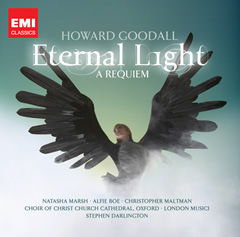
Eternal LightI recently spent an absorbing afternoon getting acquainted with Howard Goodall’s Eternal Light: A Requiem from 2008. The piece was commissioned by London Musici, and was recorded by Oxford’s Christ Church Cathedral Choir some months before its premiere with the Rambert Dance Company. As you might imagine from Goodall’s previous work, it sits squarely in the post-Rutter choral tradition of new music that is accessible to amateur choirs.

On a related theme…

In my recent post about the concept of ‘theme’ as it is used in barbershop culture, I neglected to point out its background. It is a relatively new term in the scheme of things, having been introduced into the vocabulary of the judging system in the 1993 category changes.

Maybe I should take a step back for those who aren’t familiar with the history of the barbershop judging system. Whilst there has been a relatively stable approach since the 1940s in that contests are judged by several people, each of whom has a set number of points to award in a specific category with its own particular focus, the number of categories, their names and their scoring methods have undergone periodic revisions over the years.*

Range Conversions

I had an email over the weekend from Leah, who had been interested in my arrangement of Michael Bublé’s Everything, in which she pointed out:

It's kind of hard for us to try it without knowing what ranges the song will have in a women's key. Can you give me an idea of that? thanks!

And I thought – I bet she’s not the only person in the world who would look at ranges for an arrangement in the other gender's key and ask that question. So, rather than just sending her a quick email, I thought I’d take a bit longer and write a whole blog post in the hope it will be helpful for other people too.

Musical Unity and Musical Vision

The Romantic idealThe Romantic idealOne of the aesthetic truisms that I absorbed during my undergraduate education, and have spent the subsequent years questioning,* is that great music has the quality of unity. This was purported to arrive in the music as the unconscious result of the composer’s genius, but could be uncovered via technical analysis. There were different dimensions in which you could identify this unity, Schenkerian tonal coherence and more or less hidden motivic connection in the manner of Réti being chief among them.

Even as a student, I was faintly perplexed by the equation of a spiritual attribute with concrete, technical details. I had a composer friend who was deeply taken by this aesthetic, and I used to ask him why, if the point about unity in great music was that it was created unconsciously, did he spend so much conscious effort constructing the motivic structure of his music? (He, on the other hand, felt I wasn’t taking our art sufficiently seriously when I upheld a valid role for whim in the compositional process.)

Arranging from someone else’s arrangement

‘The Things We Do for Love’, due to enter my catalogue next week, is the first of a smattering of arrangements I’ve been asked to do where the people who commissioned it were inspired by another a cappella group’s rendition of the song. In this case, it was the Vocal Six’s arrangement. Another example due to become available in the coming months is Sense of Sound’s performance of Justin Timberlake’s ‘Cry Me a River’ on the TV series Last Choir Standing.

On first sight, I found this a slightly intimidating task. When you’re transforming a well-known original to an a cappella ensemble, there are all sorts of ways you can worry about not living up to the original, but you know that at the heart of the game is the dual sense of recognisability and distance. The pleasures derive from both connecting with the original version and hearing it in a new guise.

But when someone has already leapt across that gap, what is the second arranger to do?

Soapbox: On the Value of Metaphors

soapboxMetaphors sometimes get a bit of a rough ride in our scientific world. There is sometimes a sense that talking about, say, voice production in anatomical terms is always and inherently better than what I have heard derided as the ‘pink fluffy cloud school of singing teaching’. Or that precise, concrete performance instructions are more grown-up than expressive imagery. ‘But do you want it louder or softer?’ is the kind of passive-aggressive put-down that players use to tell conductors to stow it with the airy-fairy stuff.

Now, I’m not going to argue against either scientific knowledge or directness of communication. Both of these are Good Things. But I am going to argue that the things they do well do not and cannot replace the things that metaphors do well, and if we replace all our figurative language with literal language, it gets harder to make good music.

There are three things that metaphors do that literal language does not.

How can I retain what I’ve learned?

Retention is the Achilles heel of a performance coach. It’s one thing to go and help an ensemble significantly improve their performance, but unless the coaching results in some kind of longer-lasting improvement, it has not done its job. It may of course have given the singers a good time, so was still a valid use of the session - but there is a difference between a fun workshop and coaching.

There are a number of elements or stages to the process of retention, and I suspect that the secret lies in combining them effectively.

National Association of Choirs Conference 2010

Suzi Digby's seminar (featuring a podium from StackaStage)Suzi Digby's seminar (featuring a podium from StackaStage)I spent last Saturday in Stevenage at the National Association of Choirs annual conference. It was the first time I had attended the event, and as I will be presenting at the 2011 conference, it was really useful to go and get a feel for what the membership were likely to find helpful. I had taken a small trade stand to promote my workshops, and was delighted to find that the venue was organised such that the corporate delegates could also go and eavesdrop on the seminars through the day!

...found this helpful?

I provide this content free of charge, because I like to be helpful. If you have found it useful, you may wish to make a donation to the causes I support to say thank you.


Archive by date

Syndicate content