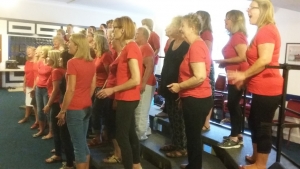
Getting to the heart of things with Red Rock Harmony

redrocksep16The post-summer-holiday coaching season leaped into action on Saturday with a return visit to Red Rock Harmony in Teignmouth. As I reported back in June, they are preparing for their first experience in national contest at the Ladies Association of British Barbershop Singers convention in October. It was cheering to be able to let them know how much progress they had made since my last visit.

With seven weeks to go before contest, there were a few moments where technical details needed sorting out, but our work was much more focused on integrating technical control with their imaginative understanding of the song. Tessitura and voicing are so often chosen by composer and arranger to evoke a certain emotional intensity, and a commitment to the narrative meaning will thus supply the level of bodily commitment the lines need to sound resonant and well-supported.

Conducting Anacruses

I recently received an email from a conductor I worked with earlier in the year with two really good questions. They thing I liked about them was that they were at one level nitty-gritty practical questions about the detail of what you do with your choir, and at another opened out into general principles with a much wider applicability than the specific technical instance he was asking about. Perfect blog-post material.

Here’s one of them:

Bringing in a less able group on an up beat has been problematic. Would you advise sticking to the proper method, and educating them, or take the line of least resistance and give them a down beat "for nothing"?

See what I mean? I’ll start with talking through the step-by-step process I’d use in this situation, then explain some of the thinking behind it, and then finish with some thoughts on the ‘line of least resistance’ dynamic, which pops up in so many different circumstances.

Self-Confidence and Self-Talk

I have been thinking recently a good deal about self-belief and conquering the demon of Impostor Syndrome. It is something that many choral leaders grapple with on and off, not just when they are new and inexperienced, but throughout their lives. It is like a chronic condition that you get under control for a good long time, and then something triggers a flare-up just when you were least expecting it.

And it’s something that mostly people deal with alone. The lovely thing about working with choirs is that you always have company in your music-making. But if you’re worried that you are letting your singers down, or that they aren’t satisfied with your efforts, you are immediately isolated from what is usually one of your primary support networks.

So this post is partly to say: you’re not alone. Many people feel like this. And you’re doing fine. The fact that you feel responsible to your ensemble and care about their experience shows that you are on the case. It’s the people who never doubt their wonderfulness who should (but don’t) worry.

The Arrangement Triangle

arrangementtriangle(Or rather, an arrangement triangle; this might not be the only aspect of the process that can be thought about in this kind of structure...)

Some years ago, a friend introduced me to a project management tool he called the Golden Triangle. It framed a project in terms of three dimensions: time, scope and resource. That is, how long you had to complete the project, what you needed to do to complete it, and what resources (human and other) you had available to do it.

The point of the triangle is that you can only ever control two out of the three dimensions. Projects, by definition, are special-occasion enterprises, things you do as one-offs, so each one is new and, whilst it may have routine elements, will overall represent something you’ve not done before. So, you will likely encounter unforeseen obstacles.

(Rehearsal) Planning for the Unknown

During the abcd Initial Conducting Course I led earlier this year, I had several conversations with conductors about how to manage rehearsal planning in the particular circumstance that you don’t yet know the much about the choir you’re planning for. How do you work out what will be appropriate repertoire when you don’t yet know the skills and experience of the singers you will be working with?

This is a circumstance that can affect anyone who is lined up with a conducting job they’ve not yet started, but it is felt most strongly in early career musicians who don’t yet have a fund of previous similar experiences to draw on.

So, the first thing is to do what profiling you can. For those moving to new teaching jobs, the age of the children you will be working with gives you quite a lot of information about what to expect, and you can also glean a good deal from what kind of repertoire your predecessor was using with them. If they have any recordings of recent performances, this will also tell you a lot.

Brief hiatus...

Just to let you know not to expect new blog posts for a couple of weeks. My attention is going to be on other things for a goodly chunk of August, and I am taking the opportunity for a proper digital detox while I'm at it.

Normal service will resume later in the month. I'm reasonably confident that you won't run out of stuff to browse in my archives in the meantime...

Music-Team Training at Junction 14

jcn14musteamI spent Saturday with the Music Team from Junction 14 chorus, delivering a bespoke workshop that touched on all three of the themes I offer for this kind of training, but with its main emphasis on Effective Rehearsal Skills. The team has welcomed two new section leaders into their posts within the last few months, so it was a good moment both to offer support to the less experienced members and to help the whole team feel more integrated as a unit.

One of the areas the team had identified in advance as something they’d like help with was knowing what to listen for in section rehearsals, and their director Hannah had suggested a checklist of target issues might be useful. It took very little time for the combined brains of the team to compile a healthy collection of things they could usefully attend to, and we then went through each systematically identifying what would be the compliment you’d give if you heard it being done well and what would be the to-do you’d ask for if it needed improving.

On Heroes and Literature Review

When Doug Harrington was teaching a tag to the assembled delegates at LABBS Harmony College back in April, he passed on some advice* that he’d been given by Jim Cline, a long-time barbershopper who had shared a good deal of wisdom and craft with the young Harrington brothers to help them on their way. It got me thinking about how and why we cite our heroes, and the ways that this functions within musical traditions in much the same way that citations and references function within academic writing.

When we choose communicate an idea we have learned from someone else, and to include in that communication where we learned it, we are doing several things at once.

...found this helpful?

I provide this content free of charge, because I like to be helpful. If you have found it useful, you may wish to make a donation to the causes I support to say thank you.


Archive by date

Syndicate content