The Dangers of Being ‘Young and Talented’

My previous two posts on this theme considered the scenario of a young, skilled musician taking on the role of director for the first time with an established choir, and, respectively, the challenges they are likely to face, and the advantages they are likely to wield. This last post in the series looks a bit wider to the dangers the category ‘young and talented’ presents to those it is applied to in general, as well as how this plays out the specific scenario of the new director.

Talent, as I have discussed before, is a mythological category. Our culture largely regards it as an inborn, innate quality, an assumption for which the literature on expertise can find no basis. Depth of skill emerges from the quantity and quality of practise someone undertakes; capacity follows rather than precedes the activity.

But, because the mythology of talent is so ubiquitous, people still use it to describe the facts of aptitude that they observe. Henry Kingsbury describes how it thus becomes a socially-negotiated label: those with authority bestow it upon junior members of that social world, giving them permission to consider themselves as particularly and specially endowed. This label can then prove a useful motivator for continued engagement: a child who is led to believe they have a special capacity for something is arguably less likely to give it up.

Music History, and the Status of Knowledge

There have been two incidents recently where the mass media portrayal of classical music has had scholars in those specific fields in a state that oscillates between outrage and despair. The first was the showing on BBC4 of Martin Jarvis’s film purporting that some of JS Bach’s works may have been written by his second wife, Anna Magdelena. The second was BBC2’s programme about the Monteverdi Vespers broadcast on Easter Saturday.

On Matching Pitch

Okay, so this is a huge topic, but I am going to see if I can keep focused on the specific thoughts that prompted me to write on the subject. These ideas arise from a combination of having read some of the scholarly literature, plus the practical experience of working with real people. So, I’d say they’re quite well-informed and well-grounded, but not comprehensive. I reserve the right, as ever, to revise them as I continue to learn.

It is a reasonably common question that choral directors come up with to ask how to help a member of their group who can’t match pitch. They will typically have worked with them at an individual level at some length, and continued difficulties lead them to seek advice from their peers.

Now, it strikes me that ‘matching pitch’ in the sense of being able to sing back a note heard from the piano is quite an abstract skill. And that whilst it may look to be the simple building block upon which successful participation in a choir is to be built, I suspect it is actually a more sophisticated level of activity that relies experience gained in more ‘real-life’ and less ‘laboratory’ musical situations.

Musings On Key Lifts

If my mother were writing this post, it would be tagged under my Soapbox category, and it would be a vehement denouncement of the use of the semitone key lift as a device for adding interest to repeated material. There would be particular attention to the work of John Rutter, in which she contends that it is a formulaic trick, so over-used that instead of perking up her attention it makes her heart sink with a feeling of ‘Oh no, not again’.

However, I have not yet entirely turned into my mother, so I am not going to be quite so doctrinaire. But neither am I resisting the inevitable process of family resemblance, so I’ll say she does have something of a point.

I spend rather more of my time in a cappella, as opposed to accompanied, choral worlds than she does, and so my reservations about semitone key lifts are more based around how badly they are often sung. The standard quip is that their main function is to allow a flatting ensemble to end in the same key that they started in.

The Benefits of Being ‘Young and Talented’

Having picked over some of the hurdles that face the sprightly new director when they take up their first post with an older choir in my last post, it occurred to me that there are also some advantages to this situation that it is worth pointing out. It may seem redundant to tell someone why they are fortunate to be both youthful and skilled, but when you are struggling against the twin obstacles of inexperience and condescension, it doesn’t necessarily feel as enviable as outsiders assume.

But there is a specific advantage that any new director has, and which is amplified significantly by both the qualities of relative youth and high skill. Your very existence bounces people out of their comfort zones.

The Challenges of Being ‘Young and Talented’

There’s a scenario that happens frequently enough that it is possible to generalise about: a well-established choir acquiring a ‘young and talented’, but relatively inexperienced director. I put the ‘young and talented’ in scare quotes, as that’s how the director is usually described by the choir, but may not be how I would put it.

The dimension of youth is generally quite clear (though possibly not quite as purely objective as you might think - the perception of juniority can be magnified or diminished by other factors such as gender and class). But the concept of ‘talent’, as regular readers will know, is open to critique - it is a concept that mythologises the products of dedication as innate rather than hard-won.

Hallmark Healthcheck

Hallmark

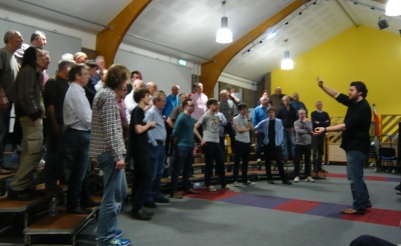
Nearly three years ago I visited Hallmark of Harmony in Sheffield to spend an evening observing their rehearsal prior to producing a report to feed into their five-year plan for the chorus’s development. In the intervening time they have gone from success to success, having won a succession of contest medals, the most recent one of which has qualified them to go and compete at the Barbershop Harmony Society’s International Convention this summer.

This week I went back for a return visit, which they framed this time as giving them a healthcheck. This seems a most apt metaphor - they have clearly found their mojo as a chorus and didn’t need help fixing problems that were conspicuously holding them back. But just as if you wait until you are suffering to seek medical advice, you miss the opportunity to nip ailments in the bud, reviewing how you are getting on as a chorus while things are going well can help you head off issues that could become problems in the future. You can also identify ways to turn good health into even better health - indeed a chorus has rather more scope to do this than the medical profession!

The Quandary of the Abandoned Assistant: Part 2

In my previous post on this subject, I was mulling over the phenomenon of reduced attendance at rehearsals taken by an assistant rather than front-line director. I had got as far as analysing it as a side-effect of the director’s function in creating charismatic encounters. It’s not that the assistants are not inspiring and compelling as people, it’s that it is the role itself of director that confers the power to galvanise.

We had got as far as starting to think about the routinization of charisma when the post got too long, so that’s where we’re starting today.

To recap the theory: Weber’s classic formulation of charismatic authority, upon which pretty much all sociological studies in this area build, saw it as an essentially volatile social relationship, born in situations of crisis, outside and indeed often in opposition to, more stable forms of authority (such as the traditional or bureaucratic). Later studies have observed that, whilst this inherent instability is often apparent in charismatic groups, some organisations manage to sustain themselves for considerable lengths of time.

...found this helpful?

I provide this content free of charge, because I like to be helpful. If you have found it useful, you may wish to make a donation to the causes I support to say thank you.


Archive by date

Syndicate content