Arranging

When’s a Good Time to Ask for Feedback?

I recently had an email conversation with someone who wanted comments on an arrangement, that framed the request for feedback as a matter of urgency, as they wanted to get the teach tracks out to their chorus. As it happens, I was in a position to juggle my schedule to fit this in, but at the same time I felt it only fair to question whether this was the right moment to be doing this.

This is a conversation I used to have frequently with students in my years as a lecturer. It was a reasonably common pattern for someone to work on an essay at length and then come for feedback only a day or two before the deadline. Often this was because they either felt there was no point in bothering me while there were still things they knew needed fixing or because they were embarrassed to show me work in an obviously incomplete (and therefore as yet inadequate) state – which does feel a bit like answering the door in your pyjamas of course. Other times it had a more cynical motivation – ‘just tell me it’s going to pass’ – which I felt rather less sympathy for, but actually didn’t change the answer.

Welwyn Well in Harmony

Welwyn
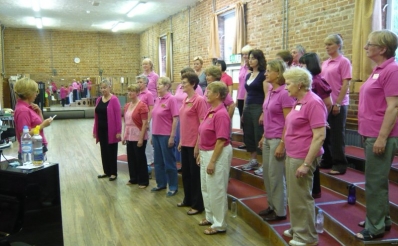
I had a fun evening on Tuesday coaching Welwyn Harmony. Earlier in the year they had commissioned an arrangement from me of ‘When I Fall in Love’, and part of our agenda on Tuesday was to work on this. I never lose the thrill of the first time I hear an arrangement sung – it’s like being in two places at once to hear something that used to just exist inside my head becoming physically audible!

And of course the possibility that I might be asked to coach a group I’ve arranged for is an important force to keep me honest as an arranger. It’s so easy, when you’re sitting at home by yourself to think, ‘Well it’s a bit awkward, but I’m sure the baritones will manage it.’ But if you know you’re going to have to face them, and indeed help them round the obstacle course you’ve constructed for them, it’s a great motivation to make the effort to make the lines singable.

Indirectly Feeding the Birds

One of the highlights of last weekend’s BABS Convention, for me, was hearing Cottontown Chorus premiere four arrangements I had done for them based on the music from Mary Poppins. The big song-and-dance numbers were of course a wonderful arranging challenge, but it’s their ballad, ‘Feed the Birds’, I’d like to talk about today. I found it a fascinating song to arrange because it is so emotionally rich in effect, though its most memorable lyrics are utterly mundane. It is a wonderful case study in indirectness of expression, of how to evoke a deep emotional response without ever really stating in the lyric why anyone should care.

A Special Weekend

Cottontown flying kites to finish their show setCottontown flying kites to finish their show setLast weekend saw British barbershoppers descend in droves on Llandudno for the 2011 BABS convention. This one was a special one for me in several ways. First, because I had the honour of hearing no fewer than eight of my arrangements receive their first performances. Five were in the chorus contest (sung by Telfordaires, Tuxedo Junction and the Cottontown Chorus), one in the quartet finals (sung by the Serious Chord Squad), and two in the Sunday afternoon show. Current LABBS gold medallists Amersham A Cappella and retiring BABS champs, the Great Western Chorus, also aired arrangements of mine in the Saturday night show.

Waiting for the Magic to Happen

Back in December, Dan Newman wrote a wonderful post about the living through that moment in the arranging process that lies between the groundwork and the realisation. This is how he describes the experience:

I’m currently in the Land of Potential under the Shadow of OverAmbition. It’s a scary place.

This is the point in the process I have described as ‘magic happens here’, and I think anyone who arranges regularly will empathise exactly with Dan’s description of what this moment is like.

Re-opening for Arrangement Commissions

This is an up-dated version of the post I wrote last time I was inviting new arrangement requests. The main changes are the dates and some additional info about logistics

Having cleared my backlog of bespoke arrangements, I am now inviting requests for new ones. I’ll be looking for about 12 to do between May and October – so, if I get up to 12 requests, I’ll do all of them, but if I get more I’ll have to pick which ones to do. This post is, firstly, to talk about the logistics of the process, and secondly to explain how I’ll make the choices if that becomes necessary.

So, first the key dates:

Please get your requests to me by Thursday 21 April 2011 and I will let you know by the end of the month if you’ve been scheduled, and for when. At that point I will ask for a deposit to secure the arrangement slot, and if you don't get back to me within 2 weeks I'll offer it to someone else.

If you’ve already been in touch trying to get ahead of the game, you’ll need to send me your request again as I have no way of knowing if you’re still interested unless you tell me you are!

When you make a request, please include the following information:

Arranging Rangy Melodies

For all that people of my parents’ generation can be quite rude about the popular music of anyone even slightly younger than them (or is it just my Dad?; the way he tells it, the rot set in with the Rolling Stones), much of the music of the last 40 years uses a significantly wider melodic range than the tunes of the 30s, 40s and 50s to which they are unkindly compared. You often don’t notice just how rangy they are because the singers handle them so well. I hadn’t realised, for instance, how wide a range George Michael covers in ‘Kissing a Fool’ until I heard Michael Bublé (not precisely an inflexible singer himself) cop out of the high notes in his cover of the song.

These songs presents something of a challenge to the close-harmony arranger. With a range that may exceed in the melodic line alone the usual range expected of an entire close-harmony ensemble, what do you do? There are three main options:

More NoteOriety

NoteOrious and FloddyI spent Saturday afternoon working with NoteOrious on two new songs they are introducing to their repertoire. For past LABBS quartet champions, it can be something of a challenge to find new goals to keep the group developing once they’ve fulfilled their contest ‘career’, and one of the ways (of several) that NoteOrious are dealing with this is clearly to give themselves more demanding repertoire to learn.

So, we spent most of the time on an arrangement of ‘Don’t Rain on My Parade’ by David Harrington. It is the one most famously sung by Max Q, though David has revoiced it somewhat for NoteOrious to sit better on their ranges.

...found this helpful?

I provide this content free of charge, because I like to be helpful. If you have found it useful, you may wish to make a donation to the causes I support to say thank you.


Archive by date

Syndicate content Syndicate content