Arranging

When Should a Pick-up be Harmonised?

'Sweet Adeline', arr. Jay Giallombardo: Jay's arrangements repay careful study for guidance on this and many other parts of our craft'Sweet Adeline', arr. Jay Giallombardo: Jay's arrangements repay careful study for guidance on this and many other parts of our craft

‘Pick-up’ is one of those informal but evocative terms people use to refer to a number of ways of easing into a phrase: one part coming in before the others, or an anticipatory propellant in the bass, or a melodic anacrusis. It’s the last of these I’m particularly thinking about here – as in the example above – and particularly in the context of ballads, where their role is much more about melodic and lyrical shape than rhythm.

So, the options with a melodic anacruses are:

  1. Give it to the lead alone, with the harmony parts coming in on the downbeat
  2. Harmonise it fully so that all parts sing it together
  3. Give it to a duet (or, more rarely, trio) as a kind of halfway house
  4. Have all parts singing, but in a reduced harmonic texture (unison or duet)

Arranger Services

You may have noticed that I have a new addition to my range of services: the Helping Arrangers section. This brings together things that were already happening on an ad hoc basis (the Mutual Mentoring Scheme for Arrangers and blog articles about arranging), with the new offering of personalised advice/tuition.

Here’s a bit of background to this addition.

A Champion Evening

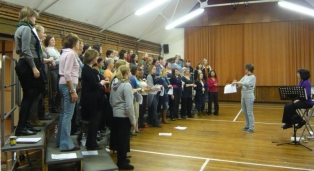
coachingamershamOn Tuesday I had my first coaching session with Amersham A Cappella since they won both the Good Housekeeping Choir of the Year competition and the LABBS chorus championship within two weeks of each other last October. They are still wearing the extraordinarily broad smiles they acquired then, and are pushing forward to build on the performance gains they made during the previous year.

Both of the arrangements we worked on on Tuesday were show pieces that use a lot of the techniques of contemporary a cappella instead of (and/or in addition to) the techniques of core barbershop. So, homophonic close-harmony textures appeared somewhat sparingly, to be replaced by more layered textures, largely driven by nonsense word-sounds (‘vocables’) used for their evocation of instrumental timbres. Hence, much of our work revolved around teasing out the details of these different textures, and balancing out the layers.

The Arranger’s Bottom Drawer

Addressing anyone here who classes themselves as either an ‘arranger’ or a ‘wanna-be-arranger’ or a ‘not-sure-I’d-claim-to-be-an-arranger-but rather-like-fiddling-around-with-notes’:

Hands up if you have a bunch of half-finished and indeed barely-started arrangements hanging around in your desk drawer and/or hard disk (depending on your preferred technology).

Have a look round – see how many people have their hands up? Pretty much everyone.

I quite often find myself in conversations with people who feel bad about this, you see, and I wish they wouldn’t. They talk about their pile of unfinished charts as if it’s something to be ashamed about, as if not turning every tune they play with into a finished product marks them as a failure. Whereas in fact it’s just a normal part of the existence of an arranger.

With One Voice...

When I was about 11, we did an art project at school that involved groups of about six painting a life-size portrait of one member of the group. I initially got the job of doing the face, and I was quite pleased with the likeness I produced. However, during a later session when I was not there (I have no recollection of why I was missing), another member of the group completely painted over all my work. I was quite hurt but, typically, didn’t say anything.

This incident came to mind back in the summer, when I was commissioned to revise Clay Hine’s arrangement of ‘I’ve Got My Love to Keep Me Warm’ for The Great British Barbershop Boys’ Christmas album. I am generally reluctant to jigger with other people’s arrangements, but I was reassured that Clay was okay with me doing so, and it was simply a matter that I happened to be available to help out in the timescale they needed. Still, I didn’t want Clay to end up feeling that I’d painted over the face of his work.

Harmonic Charge and Form

I mentioned in my post about last week's Arrangers’ Workshop that we’d talked about the relationship between the circle of fifths and the sense of a song’s form, and that it probably needed a post in its own right to cover. So, here is that post.

I’ve written before about Harmonic Charge as a measure of the inherent energy a chord has within the context of a particular key. Here, we’re just talking about dimension of harmonic charge that involves the potential energy of distance round the circle of fifths. The other dimensions (major/minor and presence/absence of a tritone) seem to me more about flavour than structure – important considerations for a song’s expressive feel, but perhaps secondary when thinking about mapping out its shape.

So, the point about the circle of fifths is that it is measure of tonal distance. Chord III is further away from ‘home’ than chord V (as it is V of VI, which is V of II, which is V of V, and then you’re nearly home). So, chords further out round the circle inherently feel more active, as you’re going to have travel further harmonically to get back home to where the music feels at rest.

Arrangers’ Workshop

NoteOrious in actionNoteOrious in action
On Sunday, a collection of arrangers from BABS, LABBS and Sweet Adelines Region 31 gathered in Birmingham for a day of honing their craft. This one of the events under the mantle of Barbershop In Harmony, and is exactly the kind of thing it’s worth collaborating over – arranging is something of a minority interest in each organisation, but between us we have a viable community of people to exchange ideas.

For this occasion, we had kind permission from Joe Liles to use a song he wrote for the Woodshedder’s Folio as a set piece for everyone to work on in advance. We had eight versions submitted in advance for workshopping, and working through these took up the bulk of the day’s activities.

Development Opportunities for Arrangers

Celebrating the back-to-school season with two opportunities for barbershop arrangers:

...found this helpful?

I provide this content free of charge, because I like to be helpful. If you have found it useful, you may wish to make a donation to the causes I support to say thank you.


Archive by date

Syndicate content Syndicate content