Charisma in Absentia: Some Case Studies

As a follow-up to my recent post on How to be Charismatic when you're not even there, I thought some examples of charismatic writing might be useful. Well, and entertaining, come to that.

First, here’s Jeremy Denk on the unmusicality of programme notes. It was browsing his blog and thinking, ‘Gosh he’s a charismatic writer,’ that led to this set of posts, so it seems a good place to start.

Confidence and Competence

I’ve been thinking a lot in recent years about confidence, and its relationship with competence. The two can so often seem to go together…but not so reliably that you can generalise about the correlation. Indeed, it is when the two seem mismatched that it feels dysfunctional. A novice who feels tentative seems as rational in their relationship with praxis as a self-possessed virtuoso. But a good performer wracked with self-doubt is a cause for concern, while an ebullient mediocrity just seems deluded.

How to be Charismatic when you're not even there

A lot of the advice you get about how to be charismatic is about presence. It covers things you should do in real time to create an aura of magnetism. Henrik Edberg, for instance, tells us to focus on things that will make other people feel good: smile, be confident, be interested in them. Andrew Leigh's book, meanwhile, counsels us to put energy into making eye contact and to act more deliberately.

Now, a lot of this is good advice for improving our social skills. Confidence, warmth, positivity, fluency are all things that are welcome in social interactions, and are frequently in evidence in people with a charismatic reputation. But they are not the same as charisma. Not all socially confident people come over as charismatic; not all charismatic people are positive or charming.

I can hear your ‘yes, buts’ bubbling up already. You want to tell me about X conductor or Y civil rights leader who had the most remarkable presence. And I believe you. But I would also contend that that aura is not the source of their charismatic power; it is at most a by-product of it. Charisma does not inherently require presence because it can work even when you are absent.

LABBS at Harrogate

Harrogate International Centre: viewed from aboveHarrogate International Centre: viewed from aboveLast weekend saw the Ladies Association of British Barbershop Singers return to their favourite venue for their annual convention. It was a week earlier than its usual spot in the calendar this year, so it overlapped with the Sweet Adelines International Convention in Houston, where LABBS 2005 and 2009 champions Finesse were making history as the first British quartet to reach an international top-10 placing.

Harold Taylor on Talent and Coordination

taylorcoverI recently re-read Harold Taylor’s short but classic book called The Pianist’s Talent. I last read it in back 1999, before I had either studied Alexander Technique or learned about Taylor from people who know him. (I’ve never actually met him or heard him play, but I have heard his daughter, Marie-Louise, perform and would recommend the experience to anyone who gets the chance.) So it was interesting to re-visit it with all kinds of new perspectives.

Soapbox: Excellence, Inclusion and Repertoire

soapboxIn my posts earlier this year responding to my correspondent interested in “Music for All” I was very restrained in not getting side-tracked onto a question about repertoire and choral ideology that he didn’t ask about directly, but chimed with various questions that used to float about when I was working at Birmingham Conservatoire. This is about how the vexed question of ‘elitism’ versus ‘inclusion’ relates to repertoire.

The stereotypical critique of so-called high-art traditions is that they are elitist, and in a number of different ways. The music was produced for the ruling classes to enjoy; to a significant extent, participation is still limited to those with the means for private education (private music lessons if not a fee-paying school); its beauty and meaning is not necessarily accessible to people who haven’t been introduced to it while young; its culturally privileged position has unreasonably maligned other (popular, commercial, participative, ethnically diverse) forms of music and treated them as less valid.

Workshopping in Lichfield

The Lichfield SingersThe Lichfield Singers

I had a happy and productive afternoon on Saturday with the Lichfield Singers, doing a workshop on the theme of Rethinking Choral Musicianship. One of the benefits of customising these workshops to individual choirs is that not only do they get the workshop time focused on the music they are currently working on, but the things we learn together are also specific to that occasion. I love that sense of knowledge arising from a particular context, and the feeling that we all go home slightly changed from when we arrived after the experience of working together.

Barbershop in Ireland

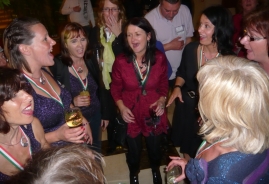
Note-Orious 8: International silver medallists Note-Orious sing with National silver medallists Note-Orious 4 in the afterglowNote-Orious 8: International silver medallists Note-Orious sing with National silver medallists Note-Orious 4 in the afterglowI spent last weekend in Galway as a judge for the Irish Association of Barbershop Singers’ convention. The association is one of the world’s smallest at around 250 members, but proportionately to the population of Ireland, this is as at least as high a participation rate as in other countries, and the convention sees an impressively high proportion of them attending.

The event punches above its weight in the barbershop calendar. This is because in addition to its national contests for quartets and choruses, it has an international dimension. Many new but ambitious quartets from Europe dip their toes into the water of contest for the first time over there, so people have learned to keep an eye on the Irish Convention for the coming new talent.

...found this helpful?

I provide this content free of charge, because I like to be helpful. If you have found it useful, you may wish to make a donation to the causes I support to say thank you.


Archive by date

Syndicate content