What Musicians can Learn from Steve Jobs about Charisma

As my musical charisma project has been developing, I have been making a collection of public figures who provide good case studies for some the processes my research has identified. Steve Jobs was pretty high on the list right from the start, and in the light of his premature passing last week, I’d like to share my notes with you. Most tributes have been about how he changed the way we listen to music; I’d like to suggest that by studying him we can also learn some useful lessons for how we make music.

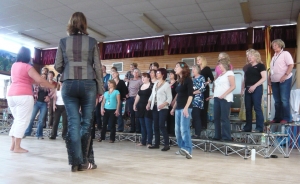
Conducting Gesture: The Choir as Co-Author

gesture_voice.JPGThe title of this post is a parody of the title of a paper by Jürgen Streeck about how people use gestures in conversation. The substance of his study was to show that gestures are not merely part of the way we broadcast our ideas as we express them to others, but are influenced by the way our interlocutors are responding. If you only look at the person talking, he suggests, you won’t fully understand why they use the gestures they do. The gestures are the result of the listener’s need to comprehend as much as the speaker’s need to communicate.

This thesis has significant implications for conducting pedagogy.

Outsourcing the Faculty of Memory

There was an interesting report on the BBC News site a while back telling of a study that suggests the internet is changing the way people use their memories. Apparently, people are increasingly treating the internet as a kind of external hard drive to store facts rather than keeping them in their own heads.

The study showed this in several ways. It found evidence (a) that when people are faced with difficult questions, they are likely to think of the internet as the place to go to answer them, (b) that people remember facts better if they know they won’t subsequently have access to reference material to remind them, and (c) that people who have the chance to store information on a computer are better at remembering where they stored it than the actual content.

Simultaneity and Coordination

legosquishBack in February when I was coaching NoteOrious, I had one of those penny-drop moments where an idea pops out that you instantly recognise needs some thinking about. In this case it was the sentence: ‘Simultaneous isn’t necessarily the same as well-coordinated’.

We often think of the concept of ensemble in primarily terms of synchronisation. Singing (or playing) at the same time is central to our perception of the ‘tightness’ of a group, and a lack of synchronisation is often the most audible symptom of slightly (or endemically) dysfunctional relationships within the group.

Jackie Roxborourgh on Types of Choir

Another session from August’s ABCD Convention that deserves individual comment is Jackie Roxborourgh’s session on community choirs. Jackie works in the world of natural voice practitioners, and so probably spends a lot time helping the people ABCD delegates were referring to as the ‘generation lost to singing’.

One of the (many) things I liked about her approach is that her focus is in helping people over the obstacles they have had with singing, whether that be childhood discouragement or exclusion in adulthood due to a lack of music literacy. So she sees it as a badge of success when people move on into other choirs – such a refreshing difference in attitude from the hoarding of members and jealousy if they ‘defect’ that you so often see.

Anyway, part of her discussion involved a compare/contrast exercise of the ‘traditional’ choir versus the ‘community’ choir.

Happy Birthday to Magenta

Magenta at MozFest, July 2011Magenta at MozFest, July 2011Tomorrow, my choir will be five years old. I will do my best not to be too self-indulgent in this moment of celebration, but anyone who has ever started anything from scratch will understand that combination of astonishment and gratitude that arises from the discovery that other people are not just willing, but happy to join in your project and make it happen.

I shouldn’t be surprised of course. People like to sing; choirs are popping up all the time. But this was the first time it was my fault the choir existed. Scary.

Singing Out for Cancer Relief

marie_curie
Marie Curie Cancer Care asked me to help publicise their Sing Out campaign. They’re asking singing groups, whether regularly constituted or put together specially for the occasion, to help them in their fund-raising with a carol-singing event during November or December.

They also have a carol specially-written by Alan Bullard available for sale, with a proportion of proceeds going to the charity.

Re-visiting Fascinating Rhythm

fascrhysep11Saturday took me back to Bristol to work once again with my friends in Fascinating Rhythm. They are in the final lap of their preparation for LABBS Convention next month, and sounding considerably more solid and confident in their songs than back in May.

The challenge for a coaching session at this stage of the performance preparation process is how to make changes that are significant enough to be major enhancements without disrupting the security developed in the rehearsals so far. In terms of Kotter’s model of change, you need to unfreeze to transform, but you don’t want to unfreeze too much at this stage, when most of the rehearsal focus is on re-freezing – i.e. locking in the skills and performance decisions so they can be delivered consistently at will.

...found this helpful?

I provide this content free of charge, because I like to be helpful. If you have found it useful, you may wish to make a donation to the causes I support to say thank you.


Archive by date

Syndicate content