The Great British Barbershop Boys

Performing at the showcase eveningPerforming at the showcase evening
This week saw the Great British Barbershop Boys unleashed on an unsuspecting universe. The quartet formerly known as Monkey Magic has been signed by Sony and rebranded. Their album, Christmas Time, is due out on December 6, but the advance publicity has started, and with a vengeance. The first press release went out on Tuesday, and within two days had appeared in one form or another in around 170 UK newspapers, whilst television coverage included an interview on daybreak and a mention on ITV Central News.

Thursday night saw a showcase event in London where the quartet sang a five-song set, and promotional copies of the album were handed out. I was invited along as one of their arrangers for the album, and it was lovely actually to see them in person after the rather manic time over the summer getting the music ready to record in a very short timescale.

123…Come & Sing!

123sing
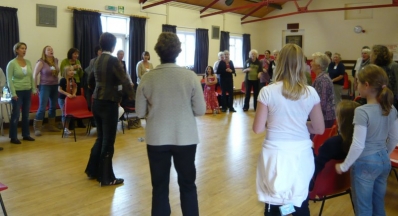
Last weekend saw singing events taking place all over the UK as part of Classic FM's 123sing! project. My contribution to the extravaganza was leading a Come & Sing workshop in Appleton, a medium-sized village in Oxfordshire. The workshop was organised and hosted by Harmony InSpires, the ladies barbershop chorus that rehearses in the next village, and through a combination of leafleting, advertising and word-of-mouth they pulled in a good sized group of participants.

A Key Question…

I found myself in a Facebook chat the other day with a newly-appointed chorus director who had found herself flummoxed at how to explain to one of her singers how you know which note is the key note. I told her that the correct answer in rehearsal is ‘Good question!’ to give yourself time to gather your thoughts.

So this post is for the singer in Sian’s chorus who asked – and for anybody else who has ever wondered, as I know it is a perennial question. It’s also one where there is a very easy answer that does you 90% of the time, but you need quite a lot more detail to be right 100% of the time.

Team Coaching with Amersham A Cappella

Warming up on Saturday morningWarming up on Saturday morning
I spent the weekend with my friends in Amersham A Cappella at their annual retreat. I was one of three coaches for the weekend, along with Nancy Kelsall and Sandra Lea-Riley of Eu4ia fame, and I found the team approach an interesting change from my regular coaching experience.

It’s been some years since I did much team coaching, and I found this weekend went significantly more smoothly than that previous experience. I’m sure being more experienced helped, as did a more equal relationship within the team (rather than being the junior partner – which is one of those problems that self-corrects over time of course). But most important was working from established relationships - Nancy and Sandra are already well accustomed to working together, and we’ve known each other a good long while too. I first worked with Eu4ia back in 2005, and we’ve spent enough time discussing ideas about music and performance together in the intervening years to have a pretty good idea of each other’s philosophies.

Why a Bad Rehearsal Isn’t Always Bad News

Do you ever have one of those evening where nothing seems to go right? Things that everyone sang with ease the week before sound like they’re sight-reading it upside down; when you gesture to start them singing, they just look at you as if you’ve done something strange and inexplicable; the vocal support sags and the tonal centre strays south.

We can sometimes identify the cause of difficult rehearsals.

Musical Meaning and Semantic Depletion

Say the word ‘moon’ out loud twenty times. After a while it stops sounding like a meaningful word with connotations of romantic June nights and/or astronauts and just starts to sound like, well, a sound. A rather silly sound, indeed.

This is a process that linguists call semantic depletion. Say something often enough and the connection between signifier (the sound that points to an idea) and signified (the idea a sound evokes) breaks down. This isn’t usually a problem in conversation, so for linguists I imagine it’s an interesting phenomenon that gives them good clues about how the mind processes language, but doesn’t present any particularly urgent practical issues.

People who rehearse their meaningful utterances have more of a problem though.

Whistle While You Work

Cupboard conceptualised to musicCupboard conceptualised to musicThe literature of musical aesthetics is littered with discussions about what music might actually be for (if anything). On one hand people can get quite huffy at the suggestion that something that we care about so much might have a merely utilitarian function, while on the other they can be equally affronted by the idea that it is simply ‘auditory cheescake’.*

I don’t have a clear theory about what the purpose of music might be in an originary sense – i.e. I couldn’t tell you why it came to be part of our life as a social species. But I do have an observation about the role it plays in ordinary life.

Driving the Key Change

Earlier this week I received an email that asked:

How do you identify which part drives the key change?

I thought I’d reply publicly, since my correspondent might not be the only person who has ever wanted to know about this. And it’s one of those questions that at one level has a simple general answer, and at another opens more complex questions.

...found this helpful?

I provide this content free of charge, because I like to be helpful. If you have found it useful, you may wish to make a donation to the causes I support to say thank you.


Archive by date

Syndicate content