
On Musical Comprehension

musicianship.JPGWhen I first started singing lessons at age 14, I was introduced to those standards of voice training, Vaccai’s exercises and Schirmer’s collection of 24 Italian songs and arias. At this stage, I was singing Italian phonetically – I knew the general gist of the words from the translations, but in expressive terms it was much like playing Mozart arias on the clarinet (which I also did around that age). Then at university I took Italian classes for 3 hours a week for a year, thinking it would be useful for someone taking voice lessons (and actually, interesting for someone who liked studying languages).

It was some years later again when I returned to the old Schirmer volume to revisit songs I had learned in my teens and had the bizarre experience of going through the motor actions I had learned to create the sounds, but now understanding the words I was singing. Bizarre and rather fun, I should add – I always enjoy the sensation when bits of my brain that hadn’t really connected before discover they have something in common.

The Cultural Politics of the Concertina

Over on This Blog Will Change the World, there is a quite wonderful post from last November laying out the aesthetic manifesto of the 'concertina-brow'. To give you a flavour of it:

The Concertina Brow reserves the right to enjoy any artistic product, activity, food, beverage, or cultural artefact of any kind, with no regard for the degree to which his tastes may or may not align with highbrows, middlebrows, lowbrows, or any other brow style of which we may not be aware. The fact that a cultural artefact was favoured by Dead, White, European Males is of no significance, either positive or negative. The opinion of his contemporaries is likewise completely irrelevant to the Concertina Brow, with the exception of individuals whose critical acumen he respects. "Popular" and "unpopular" are terms neither of approbation nor contempt.

But do go and read the whole thing – it’s worth the visit over there.

Now what the concertina brow does very well here is to navigate a coherent course between the oft-conflicting discourses of taste and quality.

No Room at the Inn…

As you’ll see from the notice on the front page, I am not taking any new orders for bespoke arrangements for the time being. It’s not that I’ll be slowing down in my arranging activity – it’s just that I’m booked up now until September, and that’s enough for the time being.

It was towards the end of last summer that I decided to regulate the flow of arrangement commissions by scheduling two per month. I had been hammering hard at it for some months already, and the requests started to come in faster than I could cope with them. It wasn’t just that I wanted to do other things with my every waking minute (I rather like going out and working with real live singers as well, for example), it was that I was starting to feel almost bloated with the amount of music I was absorbing in the process.

So, having booked up the two slots per month this far ahead, I have decided to stop accepting commissions until nearer the time I will be able to fulfil them. This is for both pragmatic and artistic reasons.

Qubic Chordmastery

Chordmasters in actionChordmasters in actionI've just had a stimulating coaching weekend in Tadcaster, home of the John Smiths brewery. On Saturday I was working with Chordmasters, a subset of the Spirit of Harmony chorus based in the Vale of York, and on Sunday with the quartet Qube. Although all of Qube also sing with Chordmasters, it turned into two quite different coaching agendas, since Chordmasters were heading towards a major performance the following week, while Qube were working on material that’s very much work-in-progress for later in the year.

Soapbox: Over-analysed or Under-thought-out?

soapboxIn a recent email conversation about various musical matters, one of the participants accused the rest of ‘over-analysing’. Our ‘gut’ should tell us what the song is about, he said, and if we get caught in the ‘brain game’ we will lose the true essence of the music.

Now, I recognise the dangers he refers to. Emotional connection is vital to make music live, and an approach that lives in the purely technical part of the brain is unlikely to find anything very meaningful to say. And I don’t think you’ll ever find me arguing against the importance of intuition in realising a song’s expressive purpose.

Having said that, the idea that the ‘gut’ has access to more valid musical expression than the brain is clearly nonsense.

Singing Long Phrases

I’ve had several conversations with members of Magenta recently in which someone has said that they find it hard to have enough breath to last to the end of the phrase. In any choir, breath control is an ongoing project, but it is also something that individuals can continue between rehearsals. So this post is for them, and for anyone else who has ever run out of breath early (so that includes me, then….).

Key Choice

How to pick the correct key for an arrangement is a core part of our basic craft as arrangers, and there are standard ways of going about it. To begin with, there are the ‘typical’ ranges for each part, and you’d start off by seeing which key would leave the melody lying in the classic range for a lead.

There isn’t always a single obvious answer from this initial process, though. Very rarely, a tune sits well within the standard range, giving room to move it up or down; more often it is going to spill over at either top or bottom. The decision at this point is inflected by multiple considerations that may not all point to the same answer. Clearly there’s the question of who is going to sing it: preferred voice range is something I’ll always ask for a commission, and I prefer it if I know the sounds of the actual voices too. It’s always good to keep your lead happy, after all.

The End of Early Music?

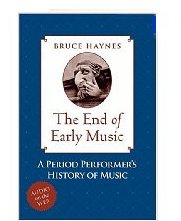
Haynes2007I’ve been dipping into Bruce Hayne’s 2007 book The End of Early Music, and enjoying it in a somewhat argumentative way. It’s written in a lively fashion, in the tradition of and strongly influenced by writers such as Christopher Small and Richard Taruskin – writers who like to take what we thought we knew and reinterpret it until they jiggle us out of our complacency.

Some people find this kind of style irritatingly unscholarly, but it’s great teaching material. Nothing like a spot of outrage to awaken the critical faculties, after all. So I find it easy to like a book that includes sentences like: ‘There was a time when “AUTHENTIC” sold records like “ORGANIC” sold tomatoes’.

...found this helpful?

I provide this content free of charge, because I like to be helpful. If you have found it useful, you may wish to make a donation to the causes I support to say thank you.


Archive by date

Syndicate content