The Role of Boundaries in Art

In a conversation at Llangollen back in July, one of the Westminster Chorus guys made a throw-away remark that got me thinking: ‘Oh good, you’re a progressive,’ he said. It rather surprised me, and I had to stop and work out why. It’s not that I think of myself as not progressive, and frankly I’d be happy to accept any compliments on offer from good-looking, nice-mannered young men who can sing as well as they do.

I’m very well acquainted with the debates of progressive versus traditional values in barbershop: it’s something I’ve published on, and as a result found myself doing a rash of newspaper and radio interviews on the question in summer 2008. But I don’t tend to think of myself as having a strongly-held position. This is partly because of my scholarly relationship with the subject – I’m more accustomed to theorising than proselytising – but also because of the British barbershop organisations’ dependence on the American. It’s their bat and their ball and so we get to play by their rules. And I’m (usually, mostly) comfortable with that.

But the conversation got me thinking about why we have these discussions, and what purpose might be served by the stylistic boundaries they define.

How to Empower our Singers

One of the things I touched on in my guest post at Owning the Stage on Musical Performance and Flow last year was the question of how much a performer is in charge of what they do, and how much they are simply following other people’s instructions. This is important, because a sense of personal control is one of the five pre-requisites for attaining a flow state.

This is a potentially tricky issue for choral directors, since we spend a lot of our time asserting our control over what our singers do. We require them to watch our gestures, to listen to and act upon our instructions, to keep changing what they do until it matches our vision. There is a risk that our desire to refine and hone the choir’s performance may get in the way of the singers’ capacity to get into that zone where they perform their best.

So, it’s worth thinking about ways we can hand control back to our singers, without relinquishing our responsibilities to the ensemble and to the music.

How Much Do Wrong Notes Matter?

There was an interesting discussion a while back among Barbershop Harmony Society Music judges about how much wrong notes should (a) affect our scores when judging and (b) be a focus for our evaluations. There was a general sense that the odd wrong note wasn’t too big a deal – especially with groups of middling attainment, where the occasional duff note rather goes with the territory. Gross or persistent errors, meanwhile, would have a greater impact on scores and would therefore become a higher priority issue to deal with in feedback afterwards.

So far, all fine and obvious. But it got me thinking about two things – the different dynamic in choral versus one-a-part ensembles, and what wrong notes tell us about musicianship.

Voice Part and Character

Towards the end of last year, Chris Rowbury wrote an interesting post about why basses can’t remember their part. He starts off thinking it’s to do with gender stereotypes: ‘it’s just a bloke thing’. This is obviously the version which, in our school days saw girls as neat and clean and obedient versus boys as messy and disorganised, but which in adulthood somehow translates for women into a lifetime of picking up their husband’s socks. (So note: whenever people voluntarily adopt an ostensibly unflattering stereotype, there’s usually also something in it for them.)

Chris moves beyond this quite soon though, and locates the difficulty basses have in the interaction between three factors: the nature of the parts in the genres he’s working in, the learning methods used, and the make-up of the group.

On Range and Tessitura

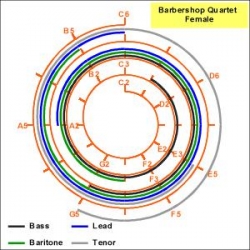
A rather nice way of showing vocal ranges visually, from PhonatureA rather nice way of showing vocal ranges visually, from PhonatureThis week saw the addition to my arrangements catalogue of information about the ranges for each part. It took quite a long time to work through all parts of every arrangement, but I’m hoping it will save you time in emailing me to ask, and me time in answering. And the process gave me lots of opportunity to reflect on the meaning and usefulness of this information.

At the most basic level, range is the primary criterion for deciding on an arrangement’s suitability for a particular ensemble. If the person singing that part doesn’t have notes used at either top or bottom, there’s no point attempting the song, as it will always over-stretch the group – and at key musical points, too. (Extremes of high and low notes never appear casually or en passant.)

But range doesn’t tell you everything you need to know about how a song lies on the voices.

Mistletoe and Clichés

There’s a funny thing about the popular music of Christmas: so much of it seems to box itself in to a limited set of elements. This is true of both the music and the lyrics. The sound world always has to involve something tinkly, either as a direct reference to sleigh bells (or maybe church bells), or as a kind of metaphorical equivalent of the twinkly things we adorn the world with at this time of year – a kind of aural tinsel. The lyrics also have a set collection of wintery iconography to evoke, listing the items that likewise turn up as figurative imagery in Christmas decorations. Cliff Richard’s 1988 hit ‘Mistletoe and Wine’ is the archetypal example, sounding almost fetishistic in its catalogue of seasonal signifiers.

Developing Musical Awareness

In my post back in March on singing semitones, I started to develop a hierarchy of musicianship by how much of the music singers are aware of. The lowest level is where they just sing their part, and the highest is where they feel as if they’re singing the music in its entirety. And it is a robust generalisation from my experience working with barbershop choruses and quartets in post-contest evaluations that the groups in which the harmony parts could not sing the tune were the choruses that scored low.

Our rehearsal processes can sometimes mitigate against the development of this kind of awareness, however. Section practices are very efficient ways to learn a part, but not at all effective ways to learn the music, for example.

Search Me!

If you ever find yourself down at the bottom of the screen on Helping You Harmonise, you may notice that a Search box has arrived. This is a sign of the site reaching a certain maturity – there is enough stuff here now that it can take a while to navigate around it using the date and category links.

Of course, people who arrive looking for something in particular will probably have gone straight to whatever it was that their external search engine suggested might meet their needs. The on-site search is more likely to be useful to people who have been here before and half-remember something they want to check back on.

...found this helpful?

I provide this content free of charge, because I like to be helpful. If you have found it useful, you may wish to make a donation to the causes I support to say thank you.


Archive by date

Syndicate content