Henry Coward and the ‘Line of Beauty’

Henry CowardHenry CowardI have been re-reading Henry Coward’s Choral Technique and Interpretation and it does not get less fascinating on re-acquaintance. Written in 1914, it is simultaneously a fascinating document of the musical practices and cultural values of his time, and a timeless statement of good practice for performing musicians. It is both intensely practical and deeply thought-through. Coward’s own character shines through as both strong-minded and idiosyncratic in all sorts of ways. He must have been wonderful to sing for.

The chapter on musical expression lays down a series of rules for beauty, at first in terms of painting (he credits Ruskin with putting him on this track), and then articulated as musical guidelines.

Hedonic Adaptation and Learning

Every so often as I reflect in this blog on the process of learning, I come back to the need for repetition or drill for the secure acquisition of skills. It turned up as the idea of ‘re-freezing’ when I was thinking about Kotter’s model of how to effect change, and Iacoboni’s book on mirror neurons gave some insight into the neurological processes that underlie it.

But you’ll have noticed a certain mistrust of drill even as I affirm its necessity.

Do Choir Robes Make You Sing Better?

There was a fascinating thread over on the Choralnet forums last month about the benefits or otherwise of wearing choir robes. It elicited a wide range of thoughtful and insightful responses – one of those discussions in which people had wildly contrasting views, all of which were perfectly reasonable and well-argued.

What emerged from the discussion was that the practice of wearing choir robes has very different meanings for different groups.

Unity and Variety

The balance between unity and variety in music is a technical/artistic challenge that composers have been grappling with for probably as long as they have been writing music. It seems to become a more urgent issue, however, when you head into the nineteenth century with the development of the idea that works should be individual – that they should have recognisable identities that distinguish them from all other works. There are all sorts of reasons for this aesthetic shift, but changes in listening habits are indicative. When the orchestra is the background music for a duchess’s card game, symphonies can be more generic, but when the lights are lowered to put everyone’s attention on the orchestra, the music needs to do more to distinguish itself.

Those of us writing a cappella arrangements of popular songs from the last century might be working on a more modest scale than the nineteenth-century symphonists, but we face similar artistic and technical challenges. Specifically, there is the question about how much to repeat stuff. It’s a simple question, but the answer is always interestingly non-obvious, because of the effect that repetition has on a piece’s sense of identity.

Exam Results

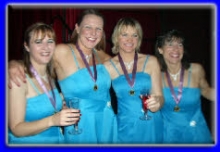
Noteorious at their Maida Vale recording sessionNoteorious at their Maida Vale recording sessionWell, Noteorious have enjoyed a good bit of airplay this week on Radio 1 – appearing not only at ungodly o’clock on Dev’s show, but popping up elsewhere through the days to promote the Masterpiece shows each evening. So, I think that means I passed the arranging test. And for those who have been sensibly asleep first thing in the morning, there are now some nice videos of them singing the arrangements on Dev’s website:


Daft Punk
The Clash
The Streets
Metallica
And an interview with clips of all four

Golden rules for rehearsing a choir

There’s lots of good advice out there for rehearsing choirs, but I’ve been trying to work out which ones are really important. I’ve made myself stick to three, since that means I can’t include just everything that’s a good idea, but have to actually prioritise. You may choose to disagree – I’d be interested if you could give your top three golden rules in the comments.

Contemplation on the Coventry Carol

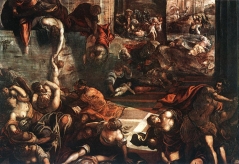
Tintoretto's depiction of the Slaughter of the InnocentsTintoretto's depiction of the Slaughter of the InnocentsI’ve been thinking just recently about the story of the slaughter of the innocents, as I’ve been working on a new arrangement of the Coventry Carol for Magenta. I find it the most unbearably sad song to sing, but there is also something compelling about reliving the story from the viewpoint of a mother whose child is killed, as the words position the singers.

Exams, Arrangements & Radio 1

NoteoriousNoteoriousMy undergraduate degree was one of those old-fashioned ones that culminated in 8 hours of written exams over two days. I recall thinking at the time, ‘Well, I think I’ve got quite good at sitting exams by now – shame really that this is the last one I’ll ever need to take’. Educationalists who like to defend the exam as an assessment strategy will point out that the capacity to complete a defined task independently within a limited timescale is a useful life skill. And I’ve always tended to think that the main legacy an exam-oriented education has left me with is the ability to focus.

But last weekend I found myself drawing much more directly on the strategies I used to use to pass exams for a real-life challenge. Noteorious, LABBS 2008 quartet champions, had been asked by BBC Radio 1 to participate in feature celebrating four classic albums. The idea was to play tracks from these albums, alternated with cuts of the quartet singing the same songs in the barbershop style. Cute idea – and they had just one week’s notice to procure and learn the arrangements before heading into the recording studio.

...found this helpful?

I provide this content free of charge, because I like to be helpful. If you have found it useful, you may wish to make a donation to the causes I support to say thank you.


Archive by date

Syndicate content