
Back with BAC
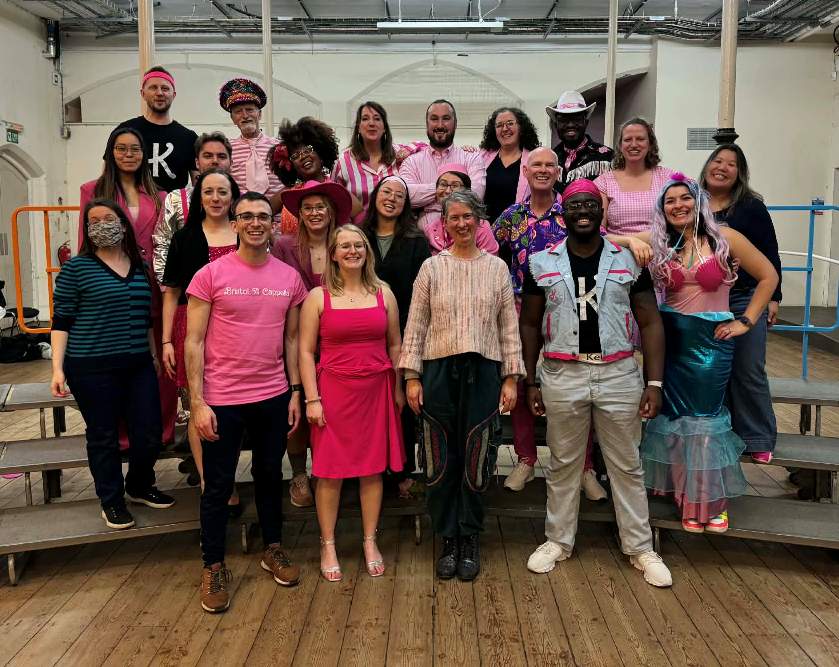
A week ago Saturday took me down to Bristol to coach Bristol A Cappella, in anticipation of their trip to Wuppertal to compete in the World Mixed Barbershop Chorus contest hosted by BinG! in March. It will be their final contest outing for the Barbie set that they took to the European and the British national contests last year. As such, we were working with material they know very well, and so the brief was all about enhancing the execution of the well-established concept rather than re-imagining anything. The main areas I was asked to focus on were resonance, swooshithroughiness, and making sure the choreography was working well with the voices.
We started off the work with a good 10 minutes or so of singing everything to a bubble. This was partly to help settle the voices into their resonance for the day: as well as the SOVT function of helping to align the vocal folds, this gets the singers connecting to their breath and also offers an extended self-massage to face and jaw to shed any tension that may have been affecting the articulation.
But it also gave useful musical information. It revealed where choreographic gestures were associated with pulses of breath that disrupted the legato, or where conductor gesture was causing a downbeat to land a bit too heavily. It also reveals the extent to which phrase boundaries are being nurtured, and if there is any extra-curricular breathing going on. (And the little I spotted during bubbling was the last I heard until nearly the end of the day; the chorus is rightly pleased to have made significant improvements in that regard.)
We then moved on to what became a global concept for the whole day of integrating the singing and the performing body. Starting with the poses from the opening tableau, which recur at an early stage in the first song, we considered how to assume these bodily positions in ways that optimised the physical set-up for singing.
This included rooting the feet into the ground, so that the weight was supported by all four corners of the feet, and with the sense that the body wasn’t just connected to the surface of the floor, but reached deep down into it, as a tree’s roots anchor it into the ground. We also thought about getting the hips above the feet, with the tailbone pointing down, and the shoulders relaxed and open, so that the shoulder blades can make friends with each other, and that the sun can shine the chest’s solar panels.
These are all the things one always thinks about when wanting to free up the voice of course, but they need thinking through anew when you’re not just standing facing front to sing. If the weight is unevenly split between the feet, for instance, it still needs to be grounded so as to allow the body to be aligned well with gravity. And if the upper body is involved in hand or arm gestures, it needs likewise not to pull the voice’s framework out of shape.
A particularly effective way of thinking about the latter point was to make sure that, whatever position the arms and hands took, or movement they made, the music always reached to the end of the fingers. I suggested this for vocal reasons, wanting to have the concept of self as singer inhabiting the full body, but it also delivered a significant upgrade in visual impact: the singers looked more committed and present when they performed in this mode. It turned out also to help them manage their stamina over a long day of rehearsing with full choreography.
Another image that helped both integrity of sound and singer stamina was to imagine those gestures in which the limbs were stretched out from the body not as casting the energy out to the world, but as inviting the world’s energy into their core.
I had spent the train journey down preparing a class on the fundamentals of conducting for an event coming up in Ireland next month, and I was struck at how much the advice one gives singers to help them inhabit their bodies in ways that facilitate their voices overlaps with the advice conductors need to produce singer-friendly gestures. This is no surprise of course: one of the central research questions for my second book was to understand why it is that the way a conductor inhabits their body affects the sound their singers make.
But it strikes me that in both cases it’s not just about the integration of body into a unit in which there is a synergy between all the parts, but also about a degree of cognitive efficiency. There is always a phase in skill development in which you have to disaggregate the different elements of technique to understand and control each, and it often feels like it’s impossible to do all of them at once and at tempo, because you only have the one brain. This is the root of the classic ‘the singing goes to pot when you add choreo’ dynamic. But the process of integration allows you to use that one brain to operate the different elements in coordination, such that they help each other work. And that’s when you can start to trust your preparation and allow the hearts of the manager and the communicator to beat as one.


You may also like ...
|
Node 2,147
Weight = 4. Common link to https://www.bristolacappella.co.uk/ (2), Two tags in common [196 posts have this] A Cappella, Coaching (2) 
|
Node 2,900
Weight = 4. Common link to https://www.bristolacappella.co.uk/ (2), Two tags in common [196 posts have this] A Cappella, Coaching (2) 
|
Node 2,843
Weight = 4. Common link to https://www.bristolacappella.co.uk/ (2), Two tags in common [196 posts have this] A Cappella, Coaching (2) 
|
Node 2,244
Weight = 4. Common link to https://www.bristolacappella.co.uk/ (2), Two tags in common [196 posts have this] A Cappella, Coaching (2) 
|
...found this helpful?
I provide this content free of charge, because I like to be helpful. If you have found it useful, you may wish to make a donation to the causes I support to say thank you.
Archive by date
- 2026 (28 posts)
- 2025 (24 posts)
- 2024 (46 posts)
- 2023 (51 posts)
- 2022 (51 posts)
- 2021 (58 posts)
- 2020 (80 posts)
- 2019 (63 posts)
- 2018 (76 posts)
- 2017 (84 posts)
- 2016 (85 posts)
- 2015 (88 posts)
- 2014 (92 posts)
- 2013 (97 posts)
- 2012 (127 posts)
- 2011 (120 posts)
- 2010 (117 posts)
- 2009 (154 posts)
- 2008 (10 posts)
