Arranging

Soapbox: Done-done with doo-doo intros

soapbox

Today’s post presents an opinion that I have been harbouring for a while, but a combination of things has brought me to the point of taking the time to articulate it. The time invested in this blog post will hopefully save me time in writing emailswhen discussing arrangement commissions, as well as giving space to develop the ideas more fully than one usually does in correspondence.

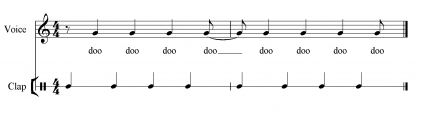
So, the doo-doo intros that I am specifically done-done with are those appended to songs intended for barbershop contest. Back in the day of course one never heard them, as the general imperative for homophony excluded passages with vocables entirely, but as things have loosened up in the last 10-15 years, there has been a willingness to accept small doses of other textures, and a concomitant profusion of songs that begin with doo-doo introductions.

Digging into the Detail with Albacappella

albacappellafeb26

I’ve just spent a happy weekend with Albacappella at their chorus retreat just outside Aberdeen. My remit was to work with them on an arrangement they had commissioned for this year’s LABBS Convention, although we also looked at their other contest piece and did some more general technique work that will apply across the board.

Some coaching trips develop a theme that runs through all our work. Looking back on this one, it feels rather more miscellaneous in focus, and thus hard to summarise. I think this is mainly because it was organised primarily around musical detail rather than skill development, so our focus shifted according to the needs of the immediate musical context. The reason for this approach is that everyone was specifically interested in what an arranger had to say about why and how they ended up with what they were singing.

Singing on the Off-Beat, Part 2

In my last post I shared some suggestions to help people develop the musicianship skills needed for singing on the off-beat. The second stage of the process is to consider the music that is asking you to deploy these skills and asking if the composer and/or arranger are facilitating your success or creating obstacles.

You see, off-beat passages are a classic example of the kind of thing a notation program can do really well, as it just produces a literal rendition untroubled by the sense-making that the human brain brings to the process of singing. And whilst sometimes (well, quite often) the problem is patchy musicianship skills in the performers, sometimes the problem is also over-optimism on the part of a writer who hasn’t spent enough of their life in rehearsal trying to help people with patchy skills achieve rhythmic security.

I left you last time with the following exercise, which reproduces the kind of thing you quite often see in a cappella arrangements, and turns out to offer a useful case study to explore this central musical question.

offbeateg6

Arranging for a Low Lead

This is kind of a niche post, as it’s about a specific challenge that we don’t come across very often. I have been arranging recently for a barbershop quartet which has a lead who more usually sings bass, which brings the melody into a rather lower tessitura than one usually uses in TTBB barbershop. This is a distinct challenge from arranging with the bass on the melody, which we do fairly frequently, although some of the things learned doing that turn out to be relevant.

Interestingly, the singer specified reference performances of the songs in the keys he wanted to sing them in, so we’re working with an established performance history of the songs in a lower tessitura. Also interesting was that a casual listen to these recordings gave me an impression of richness and warmth, but not particularly low pitch. I found myself surprised when I actually checked what keys the songs were in – and realised that particularly in one case that I had therefore a rather more challenging task than I had first imagined!

Harmonic Choices and Expressive Range

One of my stock phrases when coaching expressive performance is: The lyrics tell us what is going on, the music tells us how to feel about it. Like most stock phrases it lacks nuance in some contexts, but is a safe and useful generalisation that focuses our attention on the role that of aspects of a song that can sometimes seem quite intangible play in its communicative impact.

All musical elements play a part in shaping the sense of characterisation and emotional narrative - melody, rhythm, texture, voicing – but today I am thinking particularly about harmony. For there is a particular challenge that faces the arranger when working within the defined harmonic vocabulary of contest barbershop: how do you shop a song without making it sound just like every other barbershop song you’ve ever heard?

Exploring Characterisation with Bristol A Cappella

BACfeb25Saturday took me back to work with my friends in Bristol A Cappella on the set they are preparing for both the European Barbershop Convention in early May, and the BABS national Convention at the end of the month. As I mentioned after my last visit, whilst we have been working together for many years now, this is the first time I have arranged for them, and it brings a whole new level of intimacy to the relationship. One of the singers remarked to me about how much they wanted to do me proud, to which I replied that that was how I felt about them.

Tessitura for (Barbershop) Tenors

Quite a lot of the things I get interested in have applicability across choral genres and beyond, but today’s subject is pretty specific in focus and will likely hold little interest beyond people arranging for barbershop ensembles, and rather fewer than a quarter of the people singing it.

I had an email recently from a singer who after a good many years’ experience as a first soprano has joined a female barbershop chorus and been placed as a tenor. She had considered herself hitherto pretty confident with high notes, but is really struggling with one particular arrangement they’re currently singing, and wondered, having read a post of mine about arranging barbershop for female voices, whether the problem was the male arranger (and male chorus director in turn) not understanding the female voice.

Exciting News About Medleys!

As anyone who has been involved in sourcing arrangements for vocal ensembles over a period of years knows, the introduction of Sheet Music Plus’s ArrangeMe programme has been a game-changer. A huge proportion of in-copyright popular songs can now be arranged and published without all the time-consuming and expensive sourcing of bespoke licenses for each ensemble who wants to sing it.

...found this helpful?

I provide this content free of charge, because I like to be helpful. If you have found it useful, you may wish to make a donation to the causes I support to say thank you.


Archive by date

Syndicate content Syndicate content