
Three Blind Mice and the Rest is Guff
I sometimes dither over titles, so when someone says, ‘You should make that the title for your blog post about tonight,’ I am more than happy to take the suggestion. It will take some explanation to establish why this was one of the key ideas to emerge from my recent coaching session with Fascinating Rhythm, but we will get there in due course.
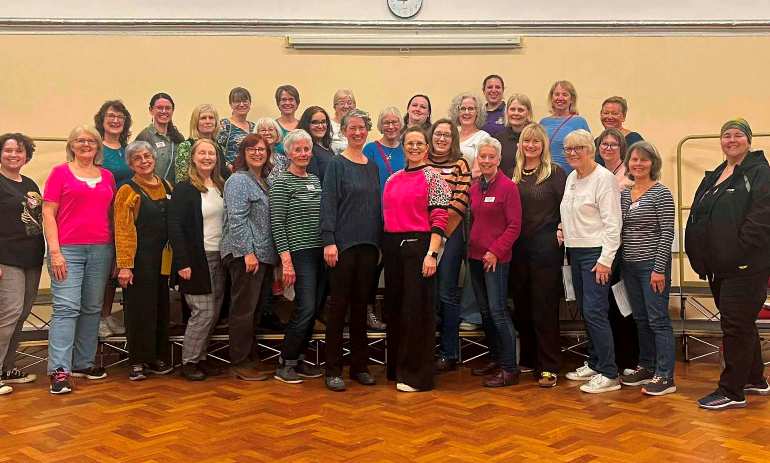
Long-time readers will know that I have had a long and happy relationship with this chorus, who went through a phase of commissioning new contest material from me every year, and then inviting me to coach them on it. This pattern was disrupted first by covid and the subsequent rebuild, and more recently by a director change. Their new MD, Wendy Howse, is settled in now though and they are rediscovering their delight in bringing never-previously-heard arrangements to sing to their peers at Convention.
Our work was a mixture of exploring song-specific issues of delivery (pacing, groove, particular details) and more generally-applicable skills that will transfer to all of their repertoire. A particular issue that they have been grappling with in a number of their songs, including the new one I was there to work on, is a loss of tonal centre, typically at the start of a song. Wendy had identified that one of the challenges with this is that it can be hard to hear that it’s happening until it’s already happened.
And, thinking about it afterwards, I realised that even for those people who find it easy to spot as soon as it starts, even then it’s kind of too late, you’re already fighting a rearguard action. What we want is to find a way to get securely settled into the key and then just stay there: the goal isn’t to stop it going flat, it’s to sing in tune. Hence, we invested a good amount of time finding our way to a place where the voices locked into the tonal centre, and once there the downward drift became occasional rather than endemic, and, when it did occur, much slighter.
Before I get into the heart of our deep work, it’s worth mentioning a few strategies we used to maintain tonal integrity once we had it established. We worked the song from the end backwards, to establish muscle memory at the right pitch; we refreshed the pitch much more often than one normally might, which limited the amount of drift possible before the key was re-established; and we worked extended passages to a bubble, which in addition to facilitating our musical objectives is very good for pitch retention.
But onto the process of finding our tonal centre. Here there were two primary strategies, used in tandem. The first was to focus on tone. Something I have been procrastinating writing about for ages is how tone is so often a predictor for other musical outcomes, in both positive and negative dimensions. When the tone is free and bright and poised, tonal centre is usually also secure; if it loses its bloom or sounds pressed, that will tell you that the pitch is about to be compromised.
Now the great thing about working on tone is not just that it is much easier to hear than tiny gradations of pitch, it’s also that you can keep connected with your expressive selves as you attend to it, rather than beating yourselves up about flatness. If you ask people to add delight, or spritz, or surprise, or sparkle, or serenity, or ecstasy to the sound, they work with their imaginative brains connecting in with the joyful dimensions of making music. It sometimes takes a number of goes to find the right adjective to help these particular people to find the quality that the note wants at that moment, but once you get there, the enlivenment to the sound guarantees its pitch.
The second strategy was to build tonal structure. If you sing note to note to note, every interval is an opportunity to drift. If you get some secure tonal pillars locked in, especially at the start of the song, all the stuff in between is less likely to pull you off track.
So, as our primary example, the bass line of the intro goes (using numbers for scale degrees):
1 [extra stuff, mostly lower than 1] 2 3
We started by taking out the extra stuff, and just locking in the scalic steps. Nerds will know that the supertonic in a cappella singing wants to be way higher than on a piano, and you don’t want to tread too heavily on the mediant. Asking people to overthink this however just makes them anxious and lost in their technical brains, so we did this entirely by working on tone: 1 2 3 = home, surprise, delight.
We then went on to add the other parts one at a time, making sure that the relationships between the parts in each chord shared these enlivened, ringy qualities. It took quite a long time to get there - longer than you might think three chords deserved - but once we were there, we could add all the extra stuff back in and it just slotted into the tonal (in both senses) world we had created.
When we were talking about this process at the end, one of the basses commented that presumably there would be other places where they could lock in the primary notes in this way, and wondered how to identify them. The answer is to look for the basic scalic steps: our original example was basically a reverse Three Blind Mice. Hence the title of today’s blog was born.
And I had to point out that as an undergraduate, I had a full ten-week course on a method of music analysis that involved learning lots of technical terms with German names, but that in a nutshell is basically ‘Three Blind Mice and the rest is guff’. Orthodox Schenkerians (whom we know from the controversies in hard-core music theory a few years back to be somewhat pompous in their gate-keeping) might regard that as disrespectfully reductive. But, you know, if anyone should be able to handle reductiveness it should be the proponents of a method that involves stripping out the detail to find the bones of the music: if they can dish it out they should be able to take it.
And I take great delight in using the insights of a method that is in its natural habitat all about upholding by intellectual means the status of a limited repertoire (and by extension the status of those that produced it and study it) to make practical music-making more effective in genres that its originator would have totally disapproved of.


You may also like ...
|
Node 2,296
Weight = 3. Three tags in common [7 posts have this] A Cappella, Coaching, Music Theory (3) 
|
Node 2,912
Weight = 3. Links to More On the Relationship of Structure to Detail (2), One tag in common [430 posts have this] Music Theory (1) 
|
Node 1,921
Weight = 3. Three tags in common [7 posts have this] A Cappella, Coaching, Music Theory (3)
|
Node 2,643
Weight = 3. Links to On Schenker and Schenkerians (2), One tag in common [430 posts have this] Music Theory (1)
|
...found this helpful?
I provide this content free of charge, because I like to be helpful. If you have found it useful, you may wish to make a donation to the causes I support to say thank you.
Archive by date
- 2026 (28 posts)
- 2025 (24 posts)
- 2024 (46 posts)
- 2023 (51 posts)
- 2022 (51 posts)
- 2021 (58 posts)
- 2020 (80 posts)
- 2019 (63 posts)
- 2018 (76 posts)
- 2017 (84 posts)
- 2016 (85 posts)
- 2015 (88 posts)
- 2014 (92 posts)
- 2013 (97 posts)
- 2012 (127 posts)
- 2011 (120 posts)
- 2010 (117 posts)
- 2009 (154 posts)
- 2008 (10 posts)
