A Cappella

Thought Experiment: Can’t Get No Dissatisfaction

A recent conversation in a barbershop arrangers facebook group has got me thinking about the role of dissatisfaction in creativity. Participants were sympathising with each other over the experience of working on a chart, and knowing it isn’t yet right, but struggling to figure out how to make it work. Anybody in any creative endeavour (and I mean that in the widest possible sense) will be having a sympathetic sigh at that thought.

I initially thought my reflections would be leading to revisit the idea of decision fatigue. There are only so many decisions we can make in any one day, and one of the points of routine is to automate as many as possible to free up cognitive capacity for the projects where you want to make some new happen. The pandemic has blown all our previous-established routines out of the water, so anyone who finds themselves too tired after work to make much progress in their arranging is not failing. They’re just having their creative capacities consumed by things other than music.

BABS Directors Academy 2021

BABSDA2021Saturday held the annual director-training event from the British Association of Barbershop Singers. As with everything these days, it was virtual rather than live, and also therefore rather shorter than usual – 5 hours rather than nearly two days. And, as with everything, this brought some brightsides along with the dilution of experience.

We inevitably had much less opportunity to bond with and learn from our fellow directors (so much learning normally happens in the bar after dinner!), though it was still lovely to see their faces. But it did mean that we could enjoy two visiting educators from the US, Cindy Hansen and Greg Clancy, rather than the one that the budget would usually run to.

Along with a contribution from Linda Corcoran, director of the Great Western Chorus of Bristol, this generated some really interesting connections between sessions, and interactions between presenters. This was clearly not entirely an accident – there were clear connections between the themes of Greg’s session on musical identity and Cindy’s on branding – but Linda’s presentation pre-figured elements of both and gave a useful concrete case-study for everyone to refer back to.

Thoughts on Barbershop and Musical Comedy

The shibboleth in barbershop circles is that any attempt at comedy has, first and foremost, to be sung well if it is to work. The better it’s sung, the funnier people will find it. This post unpicks this assumption: there’s something to it for sure, but I don’t think it tells the whole story.

The reason why this generalisation seems generally plausible is, I think, because ‘well sung’ functions as an effective proxy for ‘thoroughly-rehearsed’ and ‘has high standards’. Ensembles that develop their skills in one of these dimensions typically improve in the others too. Lurking behind the truism is the memory of mediocre performances that were not very well executed as comedy, didn’t have enough jokes in them (those they did have being rather obvious), and that were also not very well sung.

But this is a case of correlation, rather than causation. It’s not necessarily the fact that they’re singing better that makes a successful group more funny. In fact, these two dimensions are at least moderately dissociable once you’re beyond the base level of ‘does the audience trust your skillset?’

Zooming in with The Rhubarbs

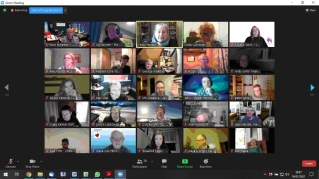
Screenshot or it didn't happen...Screenshot or it didn't happen...My last international coaching trip early in 2020 was over to Bonn to work with The Rhubarbs and their quartet, Note-4-Note. Coronavirus was in the news by then, and we compared notes about how it was regarded in the Germany versus the UK, but I don’t think we could yet imagine the impact it was going to have on us all. Whilst it is always heart-warming to see the faces of people you’re fond of over Zoom, these memories gave a little extra emotional resonance to my visit to the chorus on Tuesday evening.

Until quite recently, they had been able to meet to rehearse, and so are in the early days of their Zoom experience. So far they had largely used the platform to stay in touch rather than for musical activity, but since they’d invited me I suggested we could do some singing games while we were at it.

LABBS Chorus Day: Reflections on Style and Emotional Experience


One of my premieres for the weekend that exemplifies cheerful diatonicism

One of the things we saw coming with the LABBS Big Weekend was how, freed from the constraints of contest rules, choruses took the opportunity to share all kinds of repertoire we’d never hear on a contest stage. At a personal level, this gave me the opportunity to hear a bunch of arrangements I’d had commissioned last year that I might not otherwise have had the chance to hear at all. There was even one chart that was commissioned several years ago but that I had never heard before.

What I hadn’t anticipated was coming to the end of the day feeling that the musical diet we’d been treated to was less varied than I had expected. For sure there were lots of songs we wouldn’t normally get to hear at Convention, but in the event that also entailed hearing a lot more primarily diatonic music than usual.

LABBS Quartet Day and the Subversion of Performativity

Elena from Sonic gives the executive summary of this postElena from Sonic gives the executive summary of this postFancy title, eh? This is what happens when a familiar event takes on an unfamiliar form: you learn all kinds of things about your ‘normal’ experience that might not have come into focus without the contrast. And sometimes the things you learn inspire the use of poncy words to articulate them.

The familiar event in this case is the quartet day at the Ladies Association of British Barbershop Singers convention. In a normal year, this would involve both the semi-finals and finals of the quartet contest, featuring those ensembles who had qualified to compete at a Preliminary event back in June that combines elements both of contest and of coaching. This year it was replaced by an invitation for all quartets registered with LABBS to submit a video of up to 5 minutes; and almost 40 quartets ended up contributing.

A Weekend with the LABBS Family

I have spent every last weekend in October since 1997 at the Ladies Association of British Barbershop Singers Convention. In the year when everything was cancelled, through the vision and dedication of the LABBS Social Media team, that generalisation remains true. We were treated to the entire three-day event online: the opportunity for all member quartets and choruses to share what they had been working on, all-star shows, communal singing, the presentation of awards, the lot. We even had times when Fringe education events clashed with the main stream, only this time you only had to choose which to watch live and which on catch-up, not which to miss.

On the Melody of Harmony Parts in the Time of Covid

The value of writing harmony parts that are intuitive to sing is something I have been going on about, in various contexts, for years. At a practical level, it saves you rehearsal time; at an artistic level, it allows performers to focus on singing expressively without needing their technical brains monitoring the detail all the time.

As with so many things, the exigencies of life under covid have brought this imperative into even sharper relief. When we first took our rehearsals online, and found ourselves in a world where people can’t viably sing together, there was a lot of bright-siding on the theme of how this would require all our singers to take more individual responsibility for learning their music.

...found this helpful?

I provide this content free of charge, because I like to be helpful. If you have found it useful, you may wish to make a donation to the causes I support to say thank you.


Archive by date

Syndicate content Syndicate content