A Cappella

BAC Hat Trick

BAC2

Sunday was my third visit to Bristol A Cappella in 2016, and the last one before they sing as the first competitor in the UK’s first ever mixed barbershop chorus competition in Harrogate at the end of May. This is going to be a significant adventure for them, as whilst there is a strong core of barbershop experience in the group, the majority have no prior experience either of the specific experience of a barbershop convention, or the general experience of travelling that far and staying away from home to participate in a singing contest. But if you’re going to go on an adventure, you may as well make history while you’re at it, eh?

Our focus was thus on performance communication and mental preparation. We had a couple of technical details that needed attention, but we got them out of the way early so we could get back out of our left brains. And in the event even these turned out to be about meaning rather than technique: the notes were right but the chords weren’t locking because people were struggling to work out why they were right. Once we made sense of the progressions, the chords came into focus.

When to Use (and When to Avoid) Minor 7th Chords

So, if you’re not interested in the nitty-gritty of barbershop arranging, look away now. We have a very specific question to consider today, vital for anyone who has to choose which chords to use in a particular context, but pretty irrelevant for everyone else. Though, it does have a wider context, which both gives it a broader applicability and risks muddying the waters.

Here’s the question, raised in a group of barbershop arrangers, that set me off:

Question; why is the barbershop style opposed (for lack of a better word) to the min7 chord? I personally love the sound of it, and yet I have been told by other barbershop arrangers to avoid it where possible. Just curious why?

As you can imagine, we had some responses leaping in to the defence of the minor 7th’s beauty and/or the arranger’s right to pick whatever damn chord they choose (it wasn’t clear exactly which they were defending, but it was clear that they considered the advice out of order). So we need to step back and ask: is the barbershop style opposed to the minor 7th?

Just Peachy Coaching

justpeachyContinuing the contest-preparation season, I had a visit on Monday from Just Peachy quartet, also gearing up to LABBS prelims in June. This is a new quartet in several senses - not only have they been singing together for only 6 months, but only one has previous quartet experience, and two of them are also very new to barbershop singing. It is most exciting to help people at these early stages of their journey!

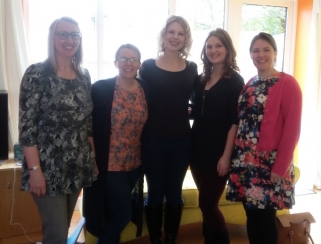
(Oh, and for the numerate amongst you, the fifth person is an extra baritone, Helen, who will be kindly standing in so they can compete despite availability difficulties.)

Something I first noticed teaching piano 20 years ago is that when people come along having identified something they’d like help with, they’re often more than halfway there with that particular challenge. The fact they ask about it signals that they are aware of the need for attention and have already been working on it. There may be things that they’ve not yet put their minds to where I can actually make more of a difference.

Swinging with Revival

RevivalSaturday brought Revival quartet over for a coaching session in preparation for the Ladies Association of British Barbershop Singers quartet prelims in June. This is a quartet that is recently formed, but brings together a lot of experience, each of the singers having sung in previous champion quartets within the association. Indeed, three of them had come here for coaching with previous quartets, so from my perspective it felt more like a reunion than a revival!

Our focus was on swing song that was in good general shape, both in terms of technical control and musical characterisation, and so ripe for bringing its detail to life. The starting-point for swing is inevitably rhythmic shape: back-beat, swung quavers, flavour/feel of the groove in dialogue with tempo. Interestingly, though, once that framework is secure (which, with a couple of momentary exceptions, it was here) you find yourself working a lot more with texture and orchestration.

On Keyboards in the A Cappella Rehearsal

I recently participated in an online conversation about the use of pianos or keyboards in a cappella rehearsals - basically, are they a Good Thing or a Bad Thing? The debate covered the pros and cons pretty much as you’d expect, and it wasn’t until a couple of weeks later that I realised that behind my general que sera sera position on the question lay a more specific, and - to me, more interesting - point.

So the main argument in favour of using a piano is the pragmatic point that we should make use of any available tool that can be useful when helping people make music. Uncomplicated and to the point - not much that needs elaborating there.

Doug Harrington and Helen Lappert on Planning for Freshness

I neglected to take a photo during the session, so here is a pic of two very positive people to set the sceneI neglected to take a photo during the session, so here is a pic of two very positive people to set the sceneAt last week’s Harmony College, I was running the Directors’ Stream, in my capacity as LABBS Chorus Director Development Specialist. (Nice job title, eh? Useful for when I need to tell people what my role is in the association these days.) Our theme for the weekend was ‘Keeping it Fresh’, and one of the ways we kept things fresh for our delegates was having input from a variety of the faculty on hand for the event.

This included a rather wonderful double act from guest educator Doug Harrington and Helen Lappert, director of Amersham A Cappella on the subject of planning for freshness. I wanted to have a mull on it today as not only did include lots of useful practical advice, but there were some interesting resonances with the session I had done on Saturday on the psychology of Flow, and with Philip Zimbardo’s ideas about our relationship with time I explored some years ago.

LABBS Harmony College 2016: Initial Reactions

Nickie James welcomes the assembled delegatesNickie James welcomes the assembled delegatesI am just home from a rather wonderful weekend with the Ladies Association of British Barbershop Singers, in which singers from all over the country gathered in Nottingham for a weekend of education and musical bonding. LABBS hasn’t used the Harmony College format for some years, having focused instead on themed and regional events on a rolling schedule. This has had the advantage of reaching more of the membership in total, as well as allowing those with multiple roles (quartet singer and chorus director, for instance) to access education for each. But there is a buzz about a big occasion like this that anyone who was there would not have wanted to miss.

I have, as you’d imagine, a pile of notes about things I learned and ideas I want to explore, both from the Directors Stream I was running and the plenary sessions. But in the first instance, as I’m writing this the morning after I got home, the impressions I’m processing are about this sense of occasion, and how it impacts on the learning process.

Story-telling with Royal Effect

royaleffectGood Friday brought Royal Effect quartet to visit for a coaching session. They are preparing for the Sweet Adelines Region 31 Convention in May, and brought their contest set along in a state where the technical challenges were largely under control leaving us to focus on the artistry of their delivery. The two songs are very different in shape and feel, but we found ourselves working with both of them in terms of narrative.

Their ballad is essentially a declaration of love that elaborates on a single, central idea. This gives it a great sense of purpose, but can make it harder to find the variety and contrasts a performance needs amongst the unity.

It becomes much easier to find shape and narrative if you recast the song as a dialogue rather than a monologue. Having established the scenario - the moment in the journey of a relationship - that the quartet imagined this moment to be taking place in, we brought the imagined beloved into the room.

...found this helpful?

I provide this content free of charge, because I like to be helpful. If you have found it useful, you may wish to make a donation to the causes I support to say thank you.


Archive by date

Syndicate content Syndicate content