A Cappella

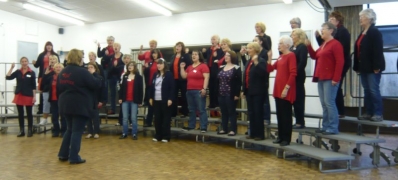
The Red Rosettes, Exploring the Song

redrosettes1

Last night was the first of two consecutive trips north-west, this one to coach the Red Rosettes in Preston. Much of the evening was dedicated to bringing out the expressive shape of a show-piece they are currently learning. But we also spent some time on the song they had used for a recent Learn to Sing course in order that their new recruits could have their first experience of being coached.

Chatting to a couple of these singers afterwards gave an interesting insight into what this experience was like for them. One spoke of the way she found it initially very challenging as it was asking her to let go of the way she had learned to do things. I thought this was a beautifully simple and to-the-point way of articulating that process of moving up from the basic operations of a new skill. Fortunately she seemed ready to take on the challenge and looked all lit up with that glow you get from achieving something new.

BABS in Bournemouth

The Bournemouth International Centre: The scene of my introduction to barbershopThe Bournemouth International Centre: The scene of my introduction to barbershopThe weekend saw the British Association of Barbershop Singers back in Bournemouth for their annual convention. This was a bit of a nostalgia-fest for me, as it was the venue of my first ever barbershop convention in 1996, and we were even staying in the same hotel as we did back then. And of course, on the first really beautiful weekend of the year after a cold winter and late-starting spring, the logical thing to do is to go to the seaside - and then spend most of the day in halls with no natural light.

The first big story of the weekend was the way that younger quartets dominated the contest, taking four of the six spots in the final, and two of the medals. Only two of these were strictly speaking 'youth quartets' as defined for contest purposes, but new champion quartet The Emerald Guard included three faces who first made their mark in British barbershop through the Youth Quartet Contest, and the other three - The QuarteTones, Taglines and current youth champs, Park Street - are all associated with university barbershop groups.

Capital Embellishments

capemb

Wednesday evening took me down to work with my friends in West London, Capital Connection. Our task was to work on two new contest songs which are quite well sung in, and thus ripe for enhancement - adding colour, nuance and emotional depth to an already well-shaped delivery.

Although it is 6 months since I last worked with the chorus, the intensive period back in the autumn of several visits in quick succession had left its mark with our working methods. It felt like we were able to cover a considerable range of musical issues in a short time: melodic flow, harmonic colour, texture and expressive register, rhythmic feel, tension and release. Actually, now I write it out, I am even more impressed by the rate at which the singers were absorbing and applying ideas to their performance.

A topic that came up with both songs was embellishment.

On Consecutive 5ths and 8ves

consecegOne of those penny-drop moments came to me when, as an undergraduate playing through some music I had written as a younger teenager (and finding it both better and worse than I remembered - does this happen to everyone when revisiting the efforts of their younger selves?), I came across a bit I'd always had to play quite carefully to make it sound okay. It could work all right, but if you didn't place it just so, it could sound a bit naff.

In the time between writing this music and revisiting it, I had been taught the concept of consecutive 5ths and 8ves, and the importance of avoiding them. This concept now revealed to me what the problem had been with my piece of juvenilia, and simultaneously made me grasp, emotionally, why I should care about this bit of theory.

There are other schools of thought on consecutives of course. Take Noel Coward:

On Tuning and Musical Meaning

Do you ever have the experience in rehearsal where people are singing the right note, but it's sitting just a shade too high or too low for the chord to gel? If you spend any time at all working a cappella, I bet you do (if you don't, you lead a charmed life).

I’m not talking about your regular, run of the mill tuning issues here, caused by tiredness, habit or faulty vocal production. I’m talking about a specific kind of fault where an ensemble that is basically in tune horizontally doesn’t always nail the vertical tuning.

Now, you can address this problem at an analytical level, asking people to nudge their note up or down a bit to get it into true. But this approach has drawbacks:

More on Choosing Songs

I have written several times on various aspects of choosing music to perform and/or to arrange. These have covered both technical and artistic criteria, and also given some ideas about process - not just what to look for but how to go about looking. I had an email conversation recently, though, with a chorus director who was looking to commission an arrangement that opened up an area right in the middle of the issues I have previously covered, but which I haven’t actually written about: which specific features should she advise her chorus members to look out for in a song that would mark it as suitable for a cappella arrangement?

Now, I used to dedicate a whole class to this question when I used to teach a course on Vocal Close Harmony at Birmingham Conservatoire. So my first instinct was just to dig out those notes and post ‘em up. But, four years on from when I last taught that course, and more years than that since I taught it in the format that included that session, I can find no trace of those notes. Deep sigh. So, we’ll have to do the thinking again from scratch.

Rote-Learning and Musicianship

Years ago, Jonathan and I took some ballroom dancing classes. It was fun it its way, but the classes weren't very good because we were simply taught a set sequence of steps for each dance without any guidance on how you would vary them in different circumstances. So we could never quick-step in a room smaller than the one we learned in, for instance, because we'd have hit the wall before we got to the turn.

I am reminded of this sometimes when working with amateur singers who have learned their music by a rote method such as learning tracks. They may have a strong and accurate grasp of the notes (the big benefit of this approach), but they lack the mental flexibility to hold the music in their heads and change their performance of it at the same time.

Soapbox: Musical Emotion, Musical Style

soapboxEmotion has a funny relationship with the nature/nurture divide. We tend to think of it as purely natural, since a lot of our emotional responses are involuntary. If it just happens to us without the intervention of our own will, it can't be a learned response, we assume. We categorise it more with digestion than with language acquisition.

And indeed, there is a substrate of primary emotional states that are cross-cultural. Joy, fear, anger, grief - we can recognise these states in people with whom we have nothing in common but our shared humanity.

But when we talk about feelings evoked by the arts, we are usually not talking about these pure forms. The emotions a novel or a symphony inspire are more subtle, mixed, contextual. And for all that 18th-century guff about music being a 'universal language', not everyone makes sense of an unfamiliar musical style on first acquaintance. Primary emotions, like the need to eat, may be universal, but the way we celebrate their full possibilities in culture develop local cuisines.

...found this helpful?

I provide this content free of charge, because I like to be helpful. If you have found it useful, you may wish to make a donation to the causes I support to say thank you.


Archive by date

Syndicate content Syndicate content