A Cappella

Re-visiting Fascinating Rhythm

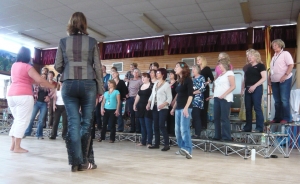
fascrhysep11Saturday took me back to Bristol to work once again with my friends in Fascinating Rhythm. They are in the final lap of their preparation for LABBS Convention next month, and sounding considerably more solid and confident in their songs than back in May.

The challenge for a coaching session at this stage of the performance preparation process is how to make changes that are significant enough to be major enhancements without disrupting the security developed in the rehearsals so far. In terms of Kotter’s model of change, you need to unfreeze to transform, but you don’t want to unfreeze too much at this stage, when most of the rehearsal focus is on re-freezing – i.e. locking in the skills and performance decisions so they can be delivered consistently at will.

Arrangers’ Mutual Mentoring Scheme

It’s time to start the 3rd annual cycle of the Mutual Mentoring Scheme for Arrangers. For those who haven’t participated before (and indeed those who have but who want to refresh their memories of how it works) there’s an overview here.

For now, I just need to say two things.

Welwyn Once Again

welwynsep11On Tuesday evening I returned to work with Welwyn Harmony, whom I had last coached back in June. It was cheering to see that they had retained a lot of the things we had worked on last time, and indeed that they were generally singing with more freedom and resonance most of the time. Helpfully, they’d sent me some recordings from the previous two rehearsals, so I was able to plan not only specific areas for coaching, but also – since they had asked me to take a vocal warm-up – devise preparatory work to introduce some specific elements we would be working on.

The work was significantly more detailed this time than last, as befits a more developed phase in the rehearsal process. In June we were looking at big-picture dimensions of rhythmic characterisation, melodic behaviour and airflow. These themes arose again on Tuesday, but usually in focusing in on specific passages or moments, to integrate them into a broadly successful approach to the songs.

JaZZmine and Musical Meaning

JaZZmine and GeorginaJaZZmine and Georgina
I spent Saturday working with JaZZmine in preparation for the quartet contest at LABBS Convention next month. This will be their first contest as a quartet, though all four singers have considerable successful experience with previous ensembles. Their qualification for convention at the Prelims contest in June came two weeks after the arrival of Paula’s daughter, Georgina, by caesarean section. That they were able to participate at all under the circumstances is impressive, though they tell me it’s not a timing they’d necessarily recommend!

Bristol Fashion: Skills and Self-Confidence

BFaug11
I spent Sunday with my friends in Bristol Fashion. I think this must have been my 5th visit in a bit over two years, and they always organise glorious weather. Even though it was drizzling when I arrived this time, once the singing started, the clouds parted. (I am sure this is nothing to either with the mild climate in the south-west of England or the fact that they always invite me in the months of May-September!)

A lot of our work this time focused less on skills per se than the psychology of confidence. There were certainly skills targeted for development (clear and positive articulation of word sounds for one), but what emerged as more central to the chorus’s quality of performance was their decision to use skills already acquired. One of the things about a group that has developed a long way in a short time is that it is very easy to default back to a lower level of performance because it is in fact not very long ago that that was the norm. They have the skills to perform with real beauty and believability to when they remember to deploy them, but they find it too easy to slip back into a more ordinary state of competence that not so long ago would have pleased them, but is no longer in the league they could be.

Tuning and Balance

Tuning is a funny thing. In some respects it is a very objective element of music, clearly explicable in terms of acoustical properties. We’ve understood perfect intervals since Pythagoras after all. But when you start measuring sounds with human ears rather than scientific instruments, things become less clear-cut.

Our ears pick up the both the fundamental of a note and the halo of overtones that all sounds other than sine waves carry with them, between the frequencies of 20 Hz and 20,000 Hz. How our brains render this collection of sounds into a perception of pitch, though, is complex and not fully understood. It’s clear we perceptually wrap the overtones into the fundamental that generates them, producing a sensation of a single note of a particular quality rather than hearing lots of different related notes as would be displayed on a spectrogram. But this combined, perceptual pitch is not necessarily identical to the fundamental: the overtones can inflect our sense of tuning as well as of quality.

Chords of Crystal

crystalchordsI spent Sunday up in Manchester working with Crystal Chords chorus, who are preparing for their second LABBS Convention under the direction of Monica Funnell. Their first contest together last autumn presented an ensemble that was developing fast, but still felt a little like work-in-progress. In the intervening months they have clearly settled into their new level of skills, although they still have that capacity to pick up new ideas quickly that characterises chorus that are undergoing rapid improvement.

The result was a most productive session. As a chorus, they were very open to coaching, and took evident pleasure in their discoveries and achievements. And we really got the benefit of the work on good vocal habits they have undertaken over the last year: at no point were our musical intentions held back by limitations in vocal technique.

Discoveries from a Quartet Project

Over the past few weeks, Magenta has undertaken a quartet project which has done all kinds of good things for us, individually and collectively. The initial rationale behind it was two-fold: first to generate a little more repertoire for a long gig we have coming up, and second as part of our 2011 goal to build all singers’ independence on their parts.

Back in May I asked who might be interested, and had 14 volunteers out of a choir of then 18 singers, which we all thought was a pretty good response rate. One later dropped out, but we still had 4 different quartets on the go, heading for a night in mid-July when we would all perform to each other. (The numerate will notice that this involved some doubling up.) I offered the three quartets in which I wasn’t singing a couple of 1-hour coaching sessions each en route, so long as they made sure they had rehearsed together before coming to see me.

...found this helpful?

I provide this content free of charge, because I like to be helpful. If you have found it useful, you may wish to make a donation to the causes I support to say thank you.


Archive by date

Syndicate content Syndicate content