A Cappella

The Barbershop Style and Opinions

One of the things a barbershop judge in the Music Category does is to adjudicate the extent to which the music competitors sing in contest actually is barbershop music. This is something I’ve been doing for years without holding particularly strong opinions about it. It’s part of the job, so I do it. But as a scholar I have analysed the way the definition of the style has developed over the last 70 years of the Barbershop Harmony Society’s evolution, which has left me with a strong sense of relativism about it all.

But by the nature of things, I meet quite a lot of people who do hold strong opinions, and they often like to harangue me about it. (And I often feel a bit sorry for them, as I tend neither to agree vehemently nor argue back, which must be most unrewarding.) They tend either to think that the style definition is far far too restrictive and that if the genre is to survive it must be liberalised at once, or that the style has been liberalised so far that it the whole genre is at risk of being lost.

Expanding In Spires

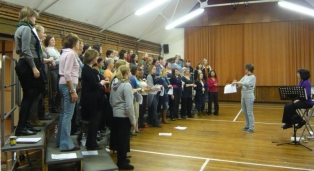
Toes to the front on the new risers!Toes to the front on the new risers!Wednesday evening took me back to Oxfordshire to have an evening’s coaching with a much expanded Harmony InSpires. Since I first visited them in 2008, they have increased in size by a good 50%, and have had to move to a new rehearsal venue to make room for everyone. Expanding membership is one of those things that people often think they need to do in order to become more successful, whereas in fact it is a result of things going well. People are attracted to participate where they can sense a buzz.

More NoteOriety

NoteOrious and FloddyI spent Saturday afternoon working with NoteOrious on two new songs they are introducing to their repertoire. For past LABBS quartet champions, it can be something of a challenge to find new goals to keep the group developing once they’ve fulfilled their contest ‘career’, and one of the ways (of several) that NoteOrious are dealing with this is clearly to give themselves more demanding repertoire to learn.

So, we spent most of the time on an arrangement of ‘Don’t Rain on My Parade’ by David Harrington. It is the one most famously sung by Max Q, though David has revoiced it somewhat for NoteOrious to sit better on their ranges.

When Should a Pick-up be Harmonised?

'Sweet Adeline', arr. Jay Giallombardo: Jay's arrangements repay careful study for guidance on this and many other parts of our craft'Sweet Adeline', arr. Jay Giallombardo: Jay's arrangements repay careful study for guidance on this and many other parts of our craft

‘Pick-up’ is one of those informal but evocative terms people use to refer to a number of ways of easing into a phrase: one part coming in before the others, or an anticipatory propellant in the bass, or a melodic anacrusis. It’s the last of these I’m particularly thinking about here – as in the example above – and particularly in the context of ballads, where their role is much more about melodic and lyrical shape than rhythm.

So, the options with a melodic anacruses are:

  1. Give it to the lead alone, with the harmony parts coming in on the downbeat
  2. Harmonise it fully so that all parts sing it together
  3. Give it to a duet (or, more rarely, trio) as a kind of halfway house
  4. Have all parts singing, but in a reduced harmonic texture (unison or duet)

Reunion with Phoenix

phoenixOn Tuesday I spent the evening down in Bedfordshire with Phoenix chorus. I worked with them quite regularly back in 2003-4, and whilst I have had regular contact with several friends from the chorus in the intervening years, this was the first time I had spent time with them as a chorus for probably 6 years. In that time, they have had some significant turn-over of membership, and I have probably changed too – so there was a sense of both picking up where we had left off and starting afresh. It certainly made me notice how my coaching style and techniques have developed over the years – though I still have quite a lot in common with my past self too.

One theme that emerged during the evening was the way that developing your musical insight into the songs makes them easier to sing in quite specifically physical/vocal ways.

A Rhythm that Fascinates

fascinatingrhyI spent last weekend with Fascinating Rhythm near Bristol for their chorus retreat. Their director, Jo Dean, has been with them two years, and they are at that productive point where they have settled into a secure working relationship, but not into a rut. Indeed, one of the minor themes of the weekend was helping Jo feel safe to keep a lighter grip on the reins now that she is getting a more immediate and nuanced response from the singers – several gestures that were needed when the chorus was first learning to read her can now be reduced and/or dropped entirely.

One major theme that emerged was that many aspects of the way you deliver a performance are contingent rather that fully definable in advance. If one part leads into a phrase, the other parts need to respond to the vocal tone they use that particular occasion, for instance. Likewise, the length of a grand pause depends on the energy and manner of release of the sound that precedes it. Come back in too soon and the audience won’t be ready for you; leave it too long and their attention will wander; gauge it right and they will meet you at the start of the next phrase.

Unsynchronised Singing

One of the perennial challenges of singing in small ensembles is simply singing together. It’s one of the primary marks of competence, second only probably to tuning. And, like tuning, underneath the basic observation that it is or isn’t working are a whole host of different types musical problems. I have become increasingly interested recently in listening for the details of poor coordination in an ensemble as a means to diagnose how to help them cure it.

I’m thinking here specifically of ensembles that sing without a director, I should add. In theory, having all singers coordinate with the gestures of a single individual out front should solve this problem. In practice, of course, synchronisation is an issue for choral groups, too. Sometimes this arises from the types of problem listed here, but sometimes it arises from things the director is doing, so it’s something of a separate question.

So far, I have identified the following ways of not singing together:

A Champion Evening

coachingamershamOn Tuesday I had my first coaching session with Amersham A Cappella since they won both the Good Housekeeping Choir of the Year competition and the LABBS chorus championship within two weeks of each other last October. They are still wearing the extraordinarily broad smiles they acquired then, and are pushing forward to build on the performance gains they made during the previous year.

Both of the arrangements we worked on on Tuesday were show pieces that use a lot of the techniques of contemporary a cappella instead of (and/or in addition to) the techniques of core barbershop. So, homophonic close-harmony textures appeared somewhat sparingly, to be replaced by more layered textures, largely driven by nonsense word-sounds (‘vocables’) used for their evocation of instrumental timbres. Hence, much of our work revolved around teasing out the details of these different textures, and balancing out the layers.

...found this helpful?

I provide this content free of charge, because I like to be helpful. If you have found it useful, you may wish to make a donation to the causes I support to say thank you.


Archive by date

Syndicate content Syndicate content