A Cappella

Silver Lining

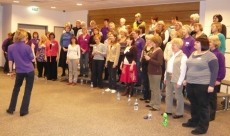
silver liningLast Wednesday I spent a fun evening with Silver Lining chorus in Coventry. It was the last session of a learn-to-sing course they’ve been running over the last few weeks, which has been both successful and popular. My session was intended as a transition from the course into the new repertoire the chorus would be starting with the participants who chose to stay on, and involved teaching a short version of my arrangement of Mamma Mia preparatory to the chorus learning the full version.

Now the challenge we set ourselves was not merely to learn all four parts of a song in a single evening, but for all singers to learn all four parts. This is possibly not as insane as it may sound, since I had originally written the arrangement for a workshop Magenta ran on the same lines, so I had designed the parts to be easily learnable. (One thing that really keeps you honest as an arranger is when you know you’ll have to teach everything you write down.) Still, it was a reasonably challenging task for singers who are accustomed to singing a single part, and learning that from a recording at their leisure. There were some who really didn’t believe we would make it!

In fact, the singers did a fabulous job.

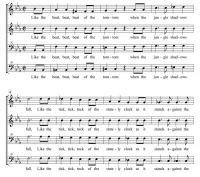
Arranging with no sharps or flats

girlswannahavefun
Close harmony styles are traditionally harmonically rich. The earliest accounts of what came to be known as barbershop harmonies in late-nineteenth-century America tell of the participants’ pleasures in discovering ever more rich and outré chords. Jazz styles later extended the harmonic vocabulary: while barbershop officially resisted the encroachment of ‘modern’ (i.e. swing) chords, barbershoppers unofficially found that the prohibition made the new dirty chords even more enticing.

But these days, ‘modern’ no longer means tunes from the 1930s, and groups that want to sing music their audiences recognise find that more recent pop is generally less harmonically rich than older popular traditions, shifting its focus much more onto rhythm and timbre as central points of interest. Richness of chording is no longer an index of hipness.

Singing Semitones

night and dayMagenta has been working on my arrangement of Night and Day recently, which has a lot of chromatic movement in the harmony parts (not my fault – Cole Porter wrote it that way). We’ve been tackling this by developing our sense of scale degrees, and the notes between them.

This is all part of my general campaign to encourage people to conceive pitch in terms of tonal context rather than in terms of intervals. I have had a clear rationale for this for some time, but recently had one of those revelatory experiences which made me realise why it was even more important in the case of semitones.

So, the basic reason to think in terms of scale degrees rather than intervals is to avoid the problem of transferred error.

Arranging non-barbershop music for barbershoppers

marmaladeBarbershop arranging benefits from a very clear-cut sense of method. There are well-defined procedures you go through that, operated with a modicum of intelligence and musicianship, will result in competent arrangements.

However, they only really work well on the kind of songs that barbershoppers traditionally sing: those with well-defined melodies and varied, functional harmonies – songs whose original form was written down. Songs whose original form was in recorded form – i.e. most pop music since the 1960s - don’t respond nearly so well to the barbershop method. But barbershoppers still want to sing them, so we have to figure out ways to make this work for them.

There are two sides to this: first, how to arrange in a way that works for the song, and second, making sure this still fits the expectations and performance habits of the singers.

Some of the issues we encounter include:

Hidden messages and performance decisions

One of the students on my Vocal Close Harmony course this semester, Amy, made the observation that you don’t see a lot of performance instructions such as dynamic markings on close-harmony arrangements. It takes somebody new to a style to point out things that you had forgotten were note-worthy - and in doing so, Amy made me think afresh about the hidden expressive codes that note-smiths (whether composers or arrangers) and performers share.

How to Spell Chords

Having inveighed at length about people spelling notes wrong in my last post, it seemed helpful to say a few words to help people get it right. This post is particularly for Matthew, who stayed after class on Monday quizzing me about spelling, but I figured if he wanted to know about it, other people might too.

Arranging to Make Singers Happy

singing group cartoonOver on Smartermusic, Dan Newman makes a passing comment in his quick ‘n’ dirty guide to a cappella arranging that I think deserves a little more attention than its brief mention there:

Entertained singers sing better

This is something that all arrangers should have engraved on their partner’s foreheads, so that they contemplate it whenever they are gazing at the person they love most in the world. It lies at the heart of my point here that elegant arrangements make groups sound better than they usually do.

But how can arrangers make singers happy? There are, I think, three dimensions to this:

Glorious Noteorious

noteoriousI spent a goodly chunk of yesterday with current LABBS Quartet champions, Noteorious, for a coaching session on two unremittingly cheerful songs: ‘Don’t Stop Me Now’ and ‘Get Happy’. They’re great to work with, because they enter into the imaginative world of what we’re working on so readily. Even if they look like they think I’ve suggested something utterly nonsensical, they jump straight in with both feet and make it work.

Reflecting on our session afterwards, I noticed two interesting things about the process of coaching:

...found this helpful?

I provide this content free of charge, because I like to be helpful. If you have found it useful, you may wish to make a donation to the causes I support to say thank you.


Archive by date

Syndicate content Syndicate content