A Cappella

Arrangements That Don’t Quite Work

One of the things that happens when you are a barbershop judge is that you get to hear multiple performances of the same arrangement. (You get it as an audience member too, but you get it more as a judge as you can’t pop out for a beer and a sandwich during the early afternoon session.) And sometimes you notice over repeated hearings that certain arrangements seem consistently to elicit sub-optimal performances.

These are arrangements that, on the face of it look fine. If there were obvious technical or artistic flaws with them, they wouldn’t get picked up by lots of groups. So it takes quite a few hearings to notice that whenever ensembles sing them, they always perform better in the other song – they’re more synchronised, better in tune and more naturally expressive. I’m not going to name specific arrangements, as I don’t think that would be polite. Rather I’ll just invite you to compile your own lists from your own listening experiences.

To Err is Human*

Toronto Northern Lights in rehearsalToronto Northern Lights in rehearsalWell, I said in my last post that Toronto Northern Light’s package that won them third place at the Barbershop Harmony Society’s International Convention recently deserved a post of its own, so here goes. It doesn’t appear to be up on Youtube so I’ll start off by describing what they did for those who haven’t seen it, and then highlight a few points as to why I admired it so much.

The first song was a medley of parodies on the theme of robots who wished they were human. All the chorus were costumed in grey overalls with all their visible skin painted in silver make-up except their director, Steve Armstrong, who played the part of the human operator. At the end of the first song, he sat down at a desk and went to sleep, while all the robots actually came ‘alive’ as humans to sing their ballad, ‘Over the Rainbow’ under the direction of their assistant director, Jordan Travis. At the end they returned to their robot world, leaving their operator to wake up with a hunch that something unusual had just occurred.

Barbershop in the City of Brotherly Love

Bird's-eye view of the Harmony Marketplace in the Pennsylvania Convention CenterBird's-eye view of the Harmony Marketplace in the Pennsylvania Convention Center
Last week saw the Barbershop Harmony Society’s annual International Convention come to the historic city of Philadelphia. It was a musically rich and socially warm event, as ever, and I came home feeling that such full immersion in the artform has made me a better musician.

Making Parts into Lines

I have written before about how I use the baritone line as a performance indicator for arrangement decisions. This is the part that is most likely to become counter-intuitive in shape as its role is to fill out the chord above and below the lead. Thus, if this line makes sense, it is a very good indication that the chord choices and voicings are good. If the line sounds illogical or bi-polar, it tells you that you need to rethink what you’re trying to do there.

I have been thinking a lot of late about the singability of all the harmony parts. This is something that all arrangers grapple with of course – both Paul Davies and David Wright have talked about it in their training sessions. But as I’ve been singing through the parts I write, I’ve been analysing both what it is that makes a part more or less singable, and the nature of the effect it will have on both singer and listener.

BABS Convention 2010

HIC's integrated social spaceHIC's integrated social space

The last weekend in May saw Britain’s barbershoppers return to one of their favourite venues for this year’s BABS Convention. The Harrogate International Centre provides not only a good-sized auditorium and enough ancillary rooms for changing and warm-ups for 37 choruses, but a wonderful central space for the social interactions that fit in an around the formal events of contest and shows. The continuity of space from area to area and level to level allows everyone to feel they are part of the same occasion, while the way the space is broken up into somewhat separately defined areas gives a sense of cosiness and intimacy.

The convention had enjoyed considerable publicity beforehand, including an article in the Independent on Sunday the previous week, which rather confusingly presented a picture of the quartet The Cardinals from 1949 as an illustration for a feature on 2008 BABS champions Monkey Magic. It also gave a nice example of how the journalistic research process is well-suited to perpetuating errors and misunderstandings; I’m sure any of their interviewees would have been happy to put the writer right on their assertion that ‘when entering competitions members are restricted to performing a list of traditional songs’.

Sweet Adelines at Gateshead

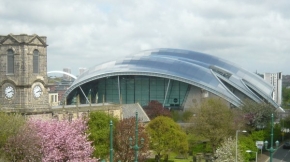
The Sage CentreThe Sage CentreLast weekend saw the Sweet Adelines Region 31 convention come to Gateshead. The Sage Centre is a great venue for this kind of event, with auditoriums designed to make live music sound wonderful, and plenty of common social spaces for people to hang out together between the performances. It’s a pity, from a convention experience perspective, that the Quartet of Nations region won’t be able to come back here in future, though I’m sure everybody is delighted about the significant increase in membership that means they’re growing out of the venue.

Amersham Again

Amersham A Cappella: warming up with Lynne OwenAmersham A Cappella: warming up with Lynne Owen
I was back in Amersham this week working with Amersham A Cappella in anticipation of their participation in the BBC Choir of the Year later this month. Their director Helen Lappert is brilliant at defining an agenda for the evening, and our goals were to:

  1. Fine-tune performances for Choir of the Year
  2. Increase the magic
  3. Enhance individuals’ performances
  4. Increase projection beyond the footlights

Arranging as Playing Cat’s Cradle

The thing that makes cat’s cradle work is the balance of opposing forces. The threads can form a structure because they are held in tension by the separated hands. Bring your hands together and this tension is released, and the three-dimensional form collapses.

I find this a useful image for juggling the competing demands a song makes on the arranger. There’s a network of opposing forces in somewhat different dimensions, both technical and artistic, pulling on the arrangement as it develops. Depending on the song and the group who’s commissioned it, the demands will vary, but there will always be this sense of simultaneous, but conflicting imperatives.

...found this helpful?

I provide this content free of charge, because I like to be helpful. If you have found it useful, you may wish to make a donation to the causes I support to say thank you.


Archive by date

Syndicate content Syndicate content