Aesthetics

Maslow for Choirs: Aesthetic Needs

aestheticsEighth post in a series that starts here

In many ways, considering a choir's aesthetic needs is a continuation of the issues that arise from their cognitive needs. Just as there is a hierarchy whereby data is processed into information, which in turn is aggregated into wisdom, there is a hierarchy of musical surface details, which get aggregated into musical structures (both of which we considered in my last post), and in turn can give rise to meaning.

Making sense of music is both about the kind of syntactical structures that are essentially cognitive and the emotional and narrative resonances that allow us to perceive beauty and meaning. It is the latter that motivates our commitment and attachment to music, but it arises from the former. It is hard to care deeply about music we don't 'get'.

The Life of Signs...

turinoI have recently been reading Thomas Turino's book Music in Social Life - which is much to be recommended as a pretty much optimal balance between intelligence and accessibility, by the way. You can tell he is both an experienced researcher and has spent lots of time framing concepts so as to make sense to non-specialist undergraduates.

One of the things I have been finding quite striking about it is the way he uses Peircean semiotics. I'm aware, by the way, that this post is going to get rather niche for a few paragraphs, but it might open out again into more generalist territory towards the end. We'll see.

I usually describe my own musicological interests in terms of being about 'music and its social meanings', which encompasses both my PhD on music and gender in historical repertories and my increasingly ethnomusicological trajectory through my two books. But right at the start of this interest lies an undergraduate dissertation on music and semiotics, that in many ways underpins everything I've done since, but which rarely shows its theoretical colours directly in what I write.

Happy Birthday to BABS

Harrogate's beautifully restored Royal HallHarrogate's beautifully restored Royal HallLast weekend saw the British Association of Barbershop Singers celebrate their 40th anniversary at an extraordinary convention in Harrogate. It was always set up to be an extraordinary occasion, what with an eye-watering 46 choruses signing up to compete on the Saturday, and a total of 7 international quartet champions visiting for the weekend.

It became more extraordinary than you would ever have imagined, though, on Friday night when a lightning strike took out the electricity supply to the auditorium and in a truly heroic effort from the BABS team and the convention centre staff, all performances were relocated to the newly-refurbished Royal Hall at the other end of the centre in time to start Saturday's contest only 10 minutes late. It was all rather astonishing.

Are You ‘A Creative’?

When I started thinking about this post, I imagined it was going to be a critique of a rather irritating article I had seen about ‘things that creatives do differently’. And I’m still irritated by it, to the extent that I’m not going to give it the compliment of linking to it. It was full of contradictory statements: creatives like to daydream, creatives are very observant; creatives like solitude, creatives like to seek out new experiences. They don’t do all of those at the same time, though, do they? If you’re day-dreaming, you’re not noticing what’s about you; if you’re alone and quiet, you’re not seeking out new experiences.

So if the idea was to learn from ‘creatives’ how to be more like them, it was no help at all. And really, I didn’t see what was so very ‘different’ about most of them. Most of the statements you could replace the word ‘creatives’ with ‘people’ and they would still ring true. I’m sure the research they were reporting on did genuinely find creative people doing all these things, but I’m not sure that tells us very much about creativity.

The Arranger's Super-Ego

I don't know quite why I started thinking in Freudian terms recently about arranging. I am sceptical in all kind of ways about Freud's theories - so many of them are so phallocentric, after all, which may feel normal for men, but just looks weird from a female perspective. But there are also ways in which he was quite humane and you can't accuse him of having not spent enough time thinking about this stuff.

Anyway, the experience that brought all this to mind was the stage of arranging I think of as 'combing' - getting all the lines lying smoothly so there aren't any tangles in the music to bump the listener, or knots in the lines to impede the singers. And I got to reflecting on how I know when an arrangement is finished.

On Artistic Freedom

On the same day I was having my revelations about feeling under the artistic thumb of over-interfering editors, a colleague/friend posted this on his Facebook timeline:

How can I put this without seeming unkind?. Putting aside my own paltry efforts in this field it was my misfortune to attend the worst piano recital today I've heard in 55 or so years of concert going; playing which would make Cherkassky and Pogorelich seem models of pianistic rectitude. Half a dozen or so (lost count) Chopin Nocturnes followed by Prokofiev's mighty 8th Sonata - a consummate display of pianistic and musical incompetence, the id always to the fore, the music merely a vehicle for a display of a grotesque psychotic disorder. Inner voices ('look how smart I am') which go nowhere except up cul-de-sacs, a musical narrative nowhere to be seen or understood; special 'effects' by the bucket load. And all accompanied by penetrating glances into the audience just to check how 'appreciative' we were of his extraordinary individuality.

It struck me that this is about as clear an argument as I’ve ever seen against the concept of ‘artistic freedom’.

On Editorial Oppression

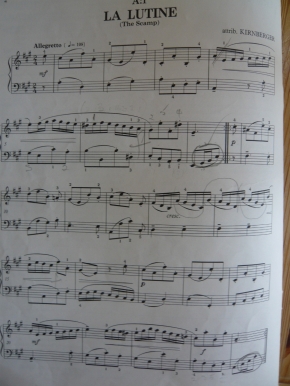
Another page from my childhood repertoireAnother page from my childhood repertoireWhen I was looking back at my childhood piano music last month, it wasn’t just the admonitory annotations that leapt out at me. I also found myself quite boggled to see quite how much editorial stuff had been added to the older pieces. Articulation, phrasing, dynamics, all kinds of stuff in profusion. I had forgotten that music used to look like this.

And you know what? I felt really boxed in by all those extraneous instructions. It was almost hard to read the notes for all the lines and dots and other paramusical paraphernalia. I hadn’t noticed how accustomed I have become to modern editorial habits that aim to strip out all the accretions of time and get back as close as possible to the text the composer produced (and to provide footnotes to tell you where the editor is having to make a guess).

Legato - Vocal or Musical?

smoothI first encountered the concept of legato as a young pianist. Which is of course, the least literal medium to engage with it. Every note a pianist plays immediately starts to die; there is no way actually to join the sound up into a line. So legato as a concept was glossed as ‘smooth’ rather than the literal ‘linked’ or ‘joined-up’ of the Italian term, and was achieved by a sleight of hand by which you manage the attacks and releases of notes to create the illusion of continuity.

So when I met ‘legato’ as a concept in singing, I was used to it as an essentially musical, even metaphorical concept. It came as something of a surprise, therefore, to discover how it operates in singing as a central element of technique. ‘Line’ is something that is achieved through a consistency of airflow, placement, and vowel shape.

...found this helpful?

I provide this content free of charge, because I like to be helpful. If you have found it useful, you may wish to make a donation to the causes I support to say thank you.


Archive by date

Syndicate content Syndicate content