Aesthetics

Musical Unity and Musical Vision

The Romantic idealThe Romantic idealOne of the aesthetic truisms that I absorbed during my undergraduate education, and have spent the subsequent years questioning,* is that great music has the quality of unity. This was purported to arrive in the music as the unconscious result of the composer’s genius, but could be uncovered via technical analysis. There were different dimensions in which you could identify this unity, Schenkerian tonal coherence and more or less hidden motivic connection in the manner of Réti being chief among them.

Even as a student, I was faintly perplexed by the equation of a spiritual attribute with concrete, technical details. I had a composer friend who was deeply taken by this aesthetic, and I used to ask him why, if the point about unity in great music was that it was created unconsciously, did he spend so much conscious effort constructing the motivic structure of his music? (He, on the other hand, felt I wasn’t taking our art sufficiently seriously when I upheld a valid role for whim in the compositional process.)

Performance Style in the Age of Recordings

One of the main interpretive challenges to face classical musicians is the ambiguity of notation. The dots on the page are very informative about what to play, but mostly leave us guessing about how. What looks like the ‘same’ notation will carry different expectations for performance style at different points in history and in different places. Formal training teaches the typical answers to these questions, and advanced training provides the research skills to seek out mores specific answers for particular repertories.

Of course, even armed with all the available information – about historical instruments, and the techniques used to play them, about the treatises on performance or aesthetics – the musician still has the imaginative task of converting that into real sounds. An interpretation thus represents a statement of how the performer concludes the music should go.

Now, for people working with popular repertories of the last 50 years or so, the task is very different, since the definitive text is now no longer on paper, but a recording.

How much do we know what we’re doing?

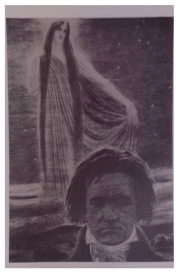
John Mayer: music as intellectJohn Mayer: music as intellectAndrew Downes: music as feelingAndrew Downes: music as feeling

At one point we had a pair of composition teachers at Birmingham Conservatoire who seemed to get on very well, but nonetheless had diametrically opposed views about how we should approach music. John Mayer used to harangue me over the photocopier about how music was nothing to do with the heart, but was an intellectual pursuit, while the then Head of Composition and Creative Studies, Andrew Downes used to say that you should never analyse anything, it should all come from the heart.

The Cultural Politics of the Concertina

Over on This Blog Will Change the World, there is a quite wonderful post from last November laying out the aesthetic manifesto of the 'concertina-brow'. To give you a flavour of it:

The Concertina Brow reserves the right to enjoy any artistic product, activity, food, beverage, or cultural artefact of any kind, with no regard for the degree to which his tastes may or may not align with highbrows, middlebrows, lowbrows, or any other brow style of which we may not be aware. The fact that a cultural artefact was favoured by Dead, White, European Males is of no significance, either positive or negative. The opinion of his contemporaries is likewise completely irrelevant to the Concertina Brow, with the exception of individuals whose critical acumen he respects. "Popular" and "unpopular" are terms neither of approbation nor contempt.

But do go and read the whole thing – it’s worth the visit over there.

Now what the concertina brow does very well here is to navigate a coherent course between the oft-conflicting discourses of taste and quality.

Soapbox: Over-analysed or Under-thought-out?

soapboxIn a recent email conversation about various musical matters, one of the participants accused the rest of ‘over-analysing’. Our ‘gut’ should tell us what the song is about, he said, and if we get caught in the ‘brain game’ we will lose the true essence of the music.

Now, I recognise the dangers he refers to. Emotional connection is vital to make music live, and an approach that lives in the purely technical part of the brain is unlikely to find anything very meaningful to say. And I don’t think you’ll ever find me arguing against the importance of intuition in realising a song’s expressive purpose.

Having said that, the idea that the ‘gut’ has access to more valid musical expression than the brain is clearly nonsense.

The End of Early Music?

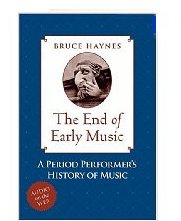
Haynes2007I’ve been dipping into Bruce Hayne’s 2007 book The End of Early Music, and enjoying it in a somewhat argumentative way. It’s written in a lively fashion, in the tradition of and strongly influenced by writers such as Christopher Small and Richard Taruskin – writers who like to take what we thought we knew and reinterpret it until they jiggle us out of our complacency.

Some people find this kind of style irritatingly unscholarly, but it’s great teaching material. Nothing like a spot of outrage to awaken the critical faculties, after all. So I find it easy to like a book that includes sentences like: ‘There was a time when “AUTHENTIC” sold records like “ORGANIC” sold tomatoes’.

The Role of Boundaries in Art

In a conversation at Llangollen back in July, one of the Westminster Chorus guys made a throw-away remark that got me thinking: ‘Oh good, you’re a progressive,’ he said. It rather surprised me, and I had to stop and work out why. It’s not that I think of myself as not progressive, and frankly I’d be happy to accept any compliments on offer from good-looking, nice-mannered young men who can sing as well as they do.

I’m very well acquainted with the debates of progressive versus traditional values in barbershop: it’s something I’ve published on, and as a result found myself doing a rash of newspaper and radio interviews on the question in summer 2008. But I don’t tend to think of myself as having a strongly-held position. This is partly because of my scholarly relationship with the subject – I’m more accustomed to theorising than proselytising – but also because of the British barbershop organisations’ dependence on the American. It’s their bat and their ball and so we get to play by their rules. And I’m (usually, mostly) comfortable with that.

But the conversation got me thinking about why we have these discussions, and what purpose might be served by the stylistic boundaries they define.

Mistletoe and Clichés

There’s a funny thing about the popular music of Christmas: so much of it seems to box itself in to a limited set of elements. This is true of both the music and the lyrics. The sound world always has to involve something tinkly, either as a direct reference to sleigh bells (or maybe church bells), or as a kind of metaphorical equivalent of the twinkly things we adorn the world with at this time of year – a kind of aural tinsel. The lyrics also have a set collection of wintery iconography to evoke, listing the items that likewise turn up as figurative imagery in Christmas decorations. Cliff Richard’s 1988 hit ‘Mistletoe and Wine’ is the archetypal example, sounding almost fetishistic in its catalogue of seasonal signifiers.

...found this helpful?

I provide this content free of charge, because I like to be helpful. If you have found it useful, you may wish to make a donation to the causes I support to say thank you.


Archive by date

Syndicate content Syndicate content