Coaching

On the 'Thought Point'

This is another of those posts bringing together bits and bobs from coaching reports about an idea (such as here and here) into one place so I can point to it and say: there, that's where I explain what this is.

The 'thought point' is a concept I have been playing with for a number of years, ever since I first came across David McNeill's concept of 'growth point' - the moment when a thought starts to occur to us. In real-life conversation, you have an inkling first, a motivation, a sense of instability that demands expression. If someone interrupts you before you get to express the idea, you may find it disappears entirely - it is not yet a fully-fledged thought, only the potential for one.

Meet Your Chimp

chimp

One of the models that Karen O’Connor shared at her Performing On Your Mind workshop last month was a way of conceptualising different functions of the brain developed by sports psychologist Steve Peters. He divides the brain into three main areas, the frontal region, which operates the logical functions, the limbic region, seat of the emotions, and the parietal region, which acts as storage.

As Karen’s slide (which she has kindly let me share with you) shows, he then characterises these as your ‘human’ brain, your ‘chimp’ brain and your ‘computer’. This is clearly a simplified model of the brain, but its usefulness lies in its very simplicity - and it does at least bear a somewhat more direct relationship with the underlying complexities than the old stereotype of left and right hemispheres. (Which itself has some similarly valuable uses as a reflective tool - it’s just taken rather too literally rather too often.)

Performing On Your Mind

Karen O'ConnorKaren O'ConnorI spent all day Thursday at a workshop on applications of sports psychology to musical performance, run by performance coach Karen O'Connor. Karen started out as an oboist (she played with the CBSO for many years), and I knew her when I worked at the Birmingham Conservatoire, where her work with students on mental skills for performance was widely admired

I am sure that knowing of her work has encouraged my own investigations into such things as adrenaline, self-talk and NLP, and it was a delight to hear her present her work, rather than learning about it piecemeal by hearsay. The ideas involved a pleasing mix of things that resonated with my current praxis, and concepts/approaches that were new to me, and the discussions between the delegates added a rich range of different perspectives on them and possibilities for their application. I would highly recommend the day to anyone involved in facilitating performance.

Cleeve Harmony and the Nature of Performance Traditions

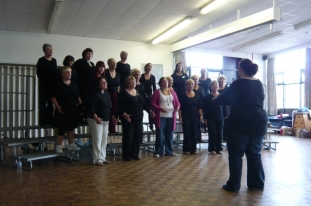
cleeveI had a rich and fascinating evening working with Cleeve Harmony near Cheltenham on Tuesday. This is a new barbershop chorus, only 10 months old, and while its membership profile is very typical in its mix of people with previous experience and people new to singing, it is striking for having only one member - its founder-director, Donna Whitehouse - with any previous barbershop experience.

My remit for the evening was primarily to help them with director-chorus communication - working with Donna on aspects of her technique, and working with the chorus on making sense of what she's doing. One of the rewarding things about such an agenda is the sense that whichever end of the equation you address, you also help the other.

New Music and Performing Confidence with Vivat!

Vivat! demonstrating the technique of standing on one leg to engage the coreVivat! demonstrating the technique of standing on one leg to engage the core

Almost exactly a year since I last worked with the West Midlands Police Choir, I was back for another workshop with them on Saturday. They have rebranded as Vivat! and have the air of a much more established choir since I last saw them. This shows not just in seeing more people at the workshop, but seeing them build the infrastructure of longer-term projects and more ambitious, such as fund-raising for a trip to France next year, amongst their more immediate rehearsal and performance goals.

The workshop had two main areas of focus.

With a Lighter Heart(beat)

heartbeatThursday took me up to Marple to work with my friends in Heartbeat Chorus. It's a couple of years since I've visited, and they have attracted lots of new members in the meantime - a sure sign that something has been going well there.

So the lightness in the title was nothing to do with numbers - quite the opposite! In fact, part of our challenge for the evening was taking a body of sound that big and getting the nimbleness and flexibility that their repertoire was asking for. I don't know why larger bodies of people should, en masse, feel like they need to move more deliberately - probably something to do with the attention required to coordinate with greater numbers. But I guess it is why it is commensurately more exciting when you achieve dexterity with a big group.

So we experienced lightness in several dimensions.

Raising the Stakes in Rehearsal

Back when I was taking lessons in Alexander Technique, my teacher introduced me to bit of psychological re-framing that I found rather striking. It was to do with habit and habit-change (of course - that is central to what AT is about), and how you manage at that point when you do something when you remember to, but often forget and let habit take over. 'If I gave you £200 every time you did this, would you do it more often?' he asked. 'Well, I can't afford to do that, but if you are able do it for £200, you are able to do it for nothing.'

What he did here was to raise the stakes. He changed forgetting to do something from a matter of little concern to one of significant lost gain. Never mind that it was purely hypothetical, he had me more emotionally and attentionally invested in the exercise.

Digging Deeper with the Red Rosettes

Red Rosettes Sept 2013Sunday saw my final, and longest, visit to the Red Rosettes before they fly off to Ireland to participate in this year’s IABS Convention. Having seen them in May, and then a month ago, it was cheering to be able to tell them that I could hear their progress from each visit to the next. This is what you’d hope would happen, of course, but it’s not always perceptible to the people plugging away week in week out.

At this stage of proceedings, it is of course far too late to mess with the general game plan. Whilst I usually describe my role as to go around messing with people’s heads, it’s also one of my life’s goals to increase people’s confidence, and making late changes to performances is a good way to have the opposite effect. So, apart from focusing in on a few isolated technical details that would benefit from specific attention, the day’s activities focused on taking a well-shaped and well-prepared performance, and making it more vivid.

...found this helpful?

I provide this content free of charge, because I like to be helpful. If you have found it useful, you may wish to make a donation to the causes I support to say thank you.


Archive by date

Syndicate content Syndicate content