Coaching

The Red Rosettes, Exploring the Song

redrosettes1

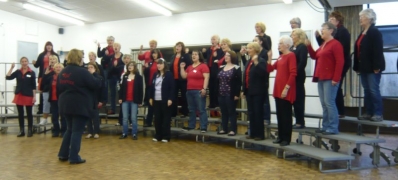
Last night was the first of two consecutive trips north-west, this one to coach the Red Rosettes in Preston. Much of the evening was dedicated to bringing out the expressive shape of a show-piece they are currently learning. But we also spent some time on the song they had used for a recent Learn to Sing course in order that their new recruits could have their first experience of being coached.

Chatting to a couple of these singers afterwards gave an interesting insight into what this experience was like for them. One spoke of the way she found it initially very challenging as it was asking her to let go of the way she had learned to do things. I thought this was a beautifully simple and to-the-point way of articulating that process of moving up from the basic operations of a new skill. Fortunately she seemed ready to take on the challenge and looked all lit up with that glow you get from achieving something new.

Nurturing the Older Voice

As I have mentioned before, I don't do very much one-to-one work, but every so often I'll do a series of half a dozen sessions with someone who approaches me for help. Six sessions is enough to make a difference, in my experience, and I tend to reckon that if someone wants to settle in for the long haul, I'd refer them on to someone whose primary focus is one-to-one work.

Now, the people I work with in this way have had a remarkably similar profile: retired ladies who sing in choirs recreationally, and are being bothered by hoarseness during the course of a rehearsal. There is no great mystery behind this consistency of profile, mind you, since all referrals have come by word of mouth along the lines of, 'Yes I had that problem, I'll tell you who helped me...'

Capital Embellishments

capemb

Wednesday evening took me down to work with my friends in West London, Capital Connection. Our task was to work on two new contest songs which are quite well sung in, and thus ripe for enhancement - adding colour, nuance and emotional depth to an already well-shaped delivery.

Although it is 6 months since I last worked with the chorus, the intensive period back in the autumn of several visits in quick succession had left its mark with our working methods. It felt like we were able to cover a considerable range of musical issues in a short time: melodic flow, harmonic colour, texture and expressive register, rhythmic feel, tension and release. Actually, now I write it out, I am even more impressed by the rate at which the singers were absorbing and applying ideas to their performance.

A topic that came up with both songs was embellishment.

How to Hear Hippos

Scott Dorsey, over on ChoralNet, has a nice blog post about the usefulness of having a fresh pair of ears in your rehearsal room. I liked it not only because he promotes the kinds of services I offer (!) but also because it got me thinking about breadth and depth of perception, and how we balance these out.

Scott uses a delightful metaphor coined by a postgraduate class-mate of 'flaming pink hippos' as representing the glaring and obvious problems that you gradually lose the ability to see the closer you get to your work. You get so focused on paying deep attention to one aspect, that you totally fail to notice much more fundamental issues developing elsewhere.

Coaching and Workshop Bookings

If you have had a coaching session or workshop with me in the last two or three years, you will have recently received an email that says:

Hello there!

I am getting in touch with people I’ve worked with in recent times to make sure I can meet as many coaching/workshop needs as possible. I find I’m having to do a fair bit of diary juggling for the period from Easter 2013 right round to Easter 2014, and I’ll be able to fit in more groups if I can sort out dates for multiple people at once rather than booking people in on an ad hoc basis.

On Comedy, Music and Retroactive Inevitability

Retroactive inevitability was a phrase used by the late Roger Payne, parody-writer extraordinaire, to describe that simultaneous sense of surprise and 'but of course'-ness you get when an end-rhyme forms a punchline.

You kind of know what's coming because of the structure that comes before, the length of phrase, the parallelisms formed by the rhyme scheme, and in the case of parodies also from your knowledge of the original song - though the structures need to make sense in their own right too. But the way the thought is completed is not entirely predictable, because the role of the comedy writer is to take us to places we hadn't necessarily thought to go.

So when the cadence-point comes, the moment of the 'reveal', it seems obvious - but only in retrospect.

The Dilts Pyramid as a Coaching Tool

diltsMy recent post about Technologies of the Self got me thinking about Robert Dilts' hierarchical model of 'neurological levels'. I mentioned this in passing in my post on neurolinguistic programming back in the autumn as something I've been thinking about blogging about for ages. Well, the time has come, because I think it offers quite a useful way to think about these 'technologies' from a practical perspective, rather than the theoretical context Foucault was working in.

First what this is. The Dilts pyramid is a model of personal change. It consists of a series of levels, each of which is constituted from, while also constraining, the one below. Hence, your capabilities define which behaviours you are able to engage in, but are also made up from your behaviours to date. And you only gain new capabilities by engaging in new behaviours.

JaZZmine and the Nature of Hearing

jazzmineWhilst I write up all my full-day or full-evening coaching sessions and workshops here (for the combined purpose of reflecting on them for myself and the enesembles, and for sharing what we learned), I don't always write up shorter sessions. An hour by Skype has a different rhythm to it from a 2-hour+ intensive. It tends to be more about sorting out details and consolidating partly-grasped areas of development than breaking new ground.

But sometimes one of these sessions will throw up something that is really asking to be written about, either for the practical techniques involved, or for what it can teach us about how people think musically. Or, in this case, both.

...found this helpful?

I provide this content free of charge, because I like to be helpful. If you have found it useful, you may wish to make a donation to the causes I support to say thank you.


Archive by date

Syndicate content Syndicate content