
Excellence

On End-Gaining

The concept of ‘end-gaining’ comes from Alexander Technique, which defines it as a kind of relationship with the world in which you are so focused on getting the result you want (gaining your end, indeed) that you go about it any way which way without adequate attention to how, or as AT puts it, the ‘means whereby’. AT is all about inhibiting habitual or impulsive responses for long enough to assert control over the means whereby you do things.

End-gaining is on the face of it about impatience. It is also about focusing on outcome goals to the exclusion of process goals. The mind-set that leads people to game the system, or - in extremis - to cheat, is one of end-gaining, as it comes with an emphasis on extrinsic rather than intrinsic rewards. In other contexts, end-gaining drives you into that state of unhappy over-practising where you hammer away at the notes of the too-hard passage without stepping back to analyse either the musical structures that holds it together or the technical skills it requires. 10,000 hours of this kind of work produces injury rather than mastery.

On Kahneman’s Two Systems and the Acquisition of Skill

kahneman

Last time I wrote about this, I gave an overview of the Daniel Kahneman’s model of two types of thinking we use, their functions, and their relationship. Today I want to mull over the implications of this for teaching and learning.

The ultimate goal of skill acquisition is to get System 1 doing all your routine operations. You want to be able to do your thing fluently, automatically, with ease and pleasure. It’s not just that it feels good to work in this mode, it’s that complex tasks need so many decisions to be coordinated that even if you had the cognitive resources to make them all in real time, it would be too slow to work properly. This is how it feels performing on a bad day when your inner voice is hectoring you: you react too late, and then you over-react.

Learning with Lemov: Without Apology

In my early years as a lecturer, I was teaching a class on music analysis one day, when a student asked, ‘And why are we learning this?’ It’s the kind of question that can come over as quite confrontational, especially when you are feeling new to the game. But it’s also a good question to ask every so often. So I talked for a short while about why I thought the method we were looking at was useful to musicians (I suspect it was Schenker, but can’t actually remember for sure). The student accepted my answer, and we went on with the class, all of us feeling some relief that we weren’t wasting our time together.

This incident came back to me as I read Doug Lemov’s principle of teaching Without Apology. If we implicitly (or indeed explicitly) apologise for the content we deliver or the people we deliver to it, we lower expectations about both the achievements that are possible or the rewards that come from achieving it. If we don’t believe in what and who we teach/conduct, who will?

So that’s a principle that’s easy to agree with in the abstract, but let’s look at some of the ways it can play out in a choral context.

Confidence, Competence and the Dunning-Kruger Effect

If you've not seen this movie, I'd recommend it for all kinds of reasons, including its illustration of the Dunning-Kruger EffectIf you've not seen this movie, I'd recommend it for all kinds of reasons, including its illustration of the Dunning-Kruger EffectI wrote some time ago about the relationship between confidence and competence, and how when prioritising learning needs the former can often act as a reasonable proxy for the latter. There was, however, some interesting psychological research towards the back end of the last century that identified circumstances in which this correlation not only breaks down but becomes positively misleading.

The Dunning-Kruger Effect refers to the way that people who are grossly incompetent at a skill will cheerfully think they are quite good at it, as below a certain skill threshold you lack the knowledge and awareness to recognise how truly bad at something you are. Conversely, experts routinely underestimate how much better they are then the merely competent because one of the hallmarks of expertise is being able to do something fluently and without struggle.

This means that if you meet someone who describes an activity as ‘ not that hard’, they are likely to be either very very good at it or very very bad.

Learning with Lemov: Achieving 100%

As an addendum to my post from last week on Lemov’s principle that 100% compliance with instruction is fundamental to the achievements of a class (and by extension, in our context, a choir), I thought it worth going into a little more detail about some of the guidance he gives for how to achieve this. It does sound scarily draconian on first acquaintance, but the point of it is to make the culture of compliance invisible so that everyone just gets on with things without having to stop and belly-ache about it.

His first point is that we should always use the least invasive form of intervention. If you can get someone back on task using just eye contact, that’s all you should use. A reminder to the group as a whole can be a way to reinforce the universality of expectations while bringing attention to the fact they still need to be met. If it needs individualising, you can start this off anonymously - I particularly liked the formulation, ‘Still waiting for 3 people...1 person...and we’re ready to go’ as a way to make individuals accountable without drawing negative attention to them.

Learning with Lemov: Right is Right, 100%

As I read through my last post on Lemov’s classroom techniques in preparation for starting this one, I noticed how certain central themes are already emerging. In particular, the principle that giving people the discretion to decide whether they commit their efforts and attention to the job in hand makes it harder for everyone to get on with it also lies at the heart of the two elements I’m going to look at today.

Lemov places ‘Right is Right’ and ‘100%’ in different sections of the book, the first in the section on setting high academic expectations, the second in the section about setting and maintaining high expectations for behaviour. Of course, both sections are about expectation-setting, so it is perhaps not surprising that their content resonates together. But it seemed to me that the two principles are much closer in the choral rehearsal than they are in the classroom, and it will be interesting to explore why.

Learning with Lemov: Taking Classroom Techniques into the Choral Rehearsal

lemovbookI have recently been reading Doug Lemov’s book, Teach Like a Champion, which I have been aware of for some years but only just got around to buying. It is a book aimed at classroom teachers, with the specific aim of helping them develop their skills in how they prepare and deliver classes. It is intensely focused on ‘concrete, specific, and actionable advice’, i.e. stuff you can do immediately and then get fluent at through practice.

I am sure I will be wanting to reflect on some of his techniques in individual posts, but before I launch into the detail, I felt the need to mull in a more general sense on, first, his basic approach, and second, how the circumstances of the rehearsal room inflect the application of his techniques.

The Clancys in Action

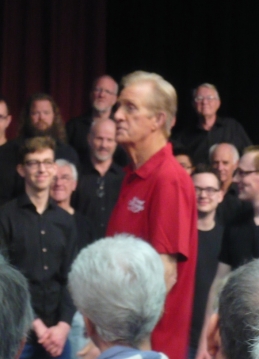
Jim Clancy: Not the best pic I've ever taken, but you can see some of the delight he is bringing to the singers on their facesJim Clancy: Not the best pic I've ever taken, but you can see some of the delight he is bringing to the singers on their facesIt was a no-brainer, at the recent BABS Convention, to go along to see Jim and Greg Clancy do a coaching workshop. You want to see how the current and founder directors of the world’s most successful barbershop chorus go about things; and if you’re me you also want to take notes and blog about it afterwards.

And it wasn’t a surprise to see Hallmark of Harmony take to the risers - since they will be representing BABS at the International Convention in Pittsburgh in just a few weeks, they were the obvious candidate for coaching. Then, when the singers took up position for the choreography, the penny finally dropped that I was about to see them coached on the song I had arranged for them. That was an exciting moment, though I did feel a bit dim for not having foreseen it.

Anyway, most of what they worked on would have been the same whatever the chorus was singing, so the rest of this blog post will stop being about me and go back to my original plan of writing about coaching methods. But the bit where Greg did focus in on the detail of the chart was wonderful - homing right in on the features that were there to make it exciting and bringing them into full musical technicolour.

...found this helpful?

I provide this content free of charge, because I like to be helpful. If you have found it useful, you may wish to make a donation to the causes I support to say thank you.


Archive by date

Syndicate content Syndicate content